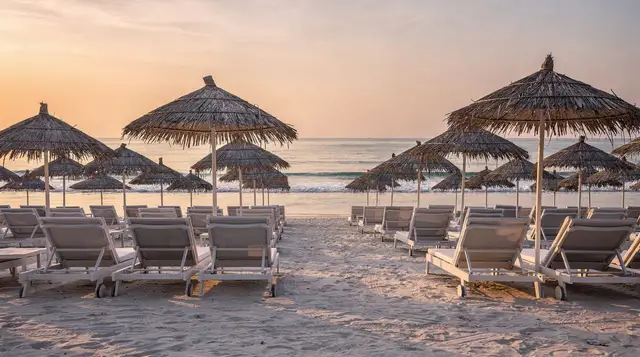
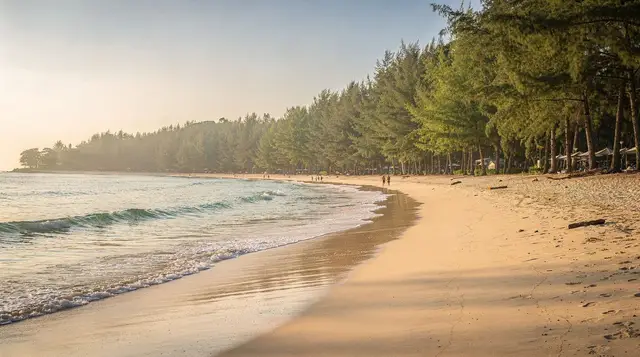
Most people who show up at Rawai with a beach towel leave disappointed within ten minutes. The shoreline here is a tidal mudflat dotted with anchored longtail boats, not a stretch of sand for swimming — and that single fact explains almost everything else about how the village works and who chooses to live here.
A pier and a market, not a beach
Rawai sits on the southern tip of Phuket, past Nai Harn and just south of Chalong. At low tide the water pulls back far enough to expose mud and rock, and even at high tide the bottom is soft and cloudy rather than sandy. Longtail boats sit moored a short distance offshore in neat rows, waiting for the day’s charter or fishing run. It’s a working waterfront, and it looks like one: nets drying on racks, ice trucks backing up to the pier, boat mechanics working on outboard motors under tarpaulin awnings.
If a beach day is the goal, Rawai isn’t it. Nai Harn is a fifteen-minute drive north and has genuinely swimmable water most of the year, and Freedom Beach is a short boat ride from the same stretch of coast if you want something quieter. Both face the open sea, so if you’re there during the May-to-October monsoon, take red flags seriously — rip currents are the leading cause of tourist deaths on Phuket, and a flagged beach isn’t worth the risk regardless of how calm it looks. See our quiet beaches in Phuket guide for the full shortlist, and the beach safety guide for the full picture.
Getting to Rawai and what it costs
There’s no rail or fixed bus timetable covering the south of the island, so getting to Rawai comes down to three realistic options, covered in more detail in our getting around Phuket guide.
| Method | Cost | Time from Phuket Town | Notes |
|---|---|---|---|
| Grab (ride-hailing app) | Around 250-350B (7-10 USD) | 20-25 minutes | Most predictable price, works well in this area |
| Metered taxi / tourist taxi | 400-600B (11-17 USD) flat rate | 20-25 minutes | Taxi stands quote a fixed price, rarely negotiable downward |
| Songthaew (shared covered truck) | Around 30-40B (under 1-1.50 USD) | 30-40 minutes, irregular | Departs from Ranong Road market area; last return run is typically mid-to-late afternoon |
| Self-drive scooter | 200-300B/day (6-9 USD) rental | 25-30 minutes | See our scooter rental guide before committing |
From Patong or Kata Beach, add another 15-20 minutes and expect to pay closer to 450-600B (13-17 USD) by Grab. The songthaew is the cheapest option by far, but it’s genuinely inconvenient if you’re not staying near the Phuket Town market where it departs, and missing the last one back means paying for a taxi anyway — factor that into the math before you commit to the bus for a whole day out. Renting a scooter yourself is the most flexible option if you’re combining Rawai with Chalong and Promthep Cape in the same day, since all three sit within a 10-15 minute ride of each other and a taxi for a multi-stop loop adds up fast.
The seafood market: how to actually order
Rawai Seafood Market is the reason most visitors make the trip. Rows of stalls display the day’s catch on ice — prawns, crab, squid, reef fish, lobster when it’s in — priced by weight and sold raw. You then carry your selection to one of the restaurants set back from the stalls, where they’ll cook it to order for a separate service charge.
This system is straightforward and can be excellent value, but it’s also the single most common spot in south Phuket for tourists to get overcharged. A few practical points:
- Confirm the weight and price before it’s cooked, not after. Ask the stall to show you the scale reading and repeat the total back in Thai baht.
- Expect to pay 800-1,500B (22-42 USD) per person for a generous seafood dinner for two sharing several dishes, depending on what you order — crab and lobster push the bill up fast, squid and reef fish keep it down.
- The cooking fee is separate from the seafood price. Ask upfront what the restaurant charges to prepare what you bought; it’s usually 100-200B (3-6 USD) per dish but isn’t always volunteered.
- Stick to stalls that are busy with local buyers, not just the ones closest to the car park — the market is large enough that quality and pricing vary noticeably stall to stall.
- Go around sunset for the most pleasant sitting, but arrive with enough daylight left to actually see what you’re buying and check the ice is still cold rather than melted.
For a guided version of the same experience with the awkward pricing negotiation handled for you, a market and sunset dinner tour bundles the walk-through with a fixed-price meal:
Rawai sunset and seafood market dinner tourFor the wider Phuket seafood scene beyond Rawai, see our seafood market guide and street food guide. If you’d rather learn to cook the same dishes than just eat them, a hands-on class run by a Rawai-based chef covers market shopping and cooking in one session — see the cooking class link below.
The Urak Lawoi sea gypsy village
At the southern end of Rawai, past the market, is a settlement of stilted homes and narrow lanes that’s often labelled a “Moken village” by tour brochures — that’s not quite accurate. The community here is Urak Lawoi, one of three distinct Chao Leh (“sea people”) groups native to this stretch of the Andaman coast. The Moken proper live much further north, around the Surin and Similan Islands near the Myanmar border, and have a different language and boat-building tradition from the Urak Lawoi.
The Rawai village is a real, functioning community — not a staged attraction — and that distinction matters for how you visit it. There’s no ticket booth or formal tour infrastructure. Walking through respectfully, buying from the small shops selling shell crafts and dried seafood, and not treating people’s homes as a photo backdrop is the expected etiquette. Families here have fished these waters for generations, and the community has faced recurring land-rights disputes with resort and hotel developers over the decades, which is part of why the settlement looks the way it does — modest, densely packed, holding its ground on some of the most valuable coastline on the island.
If you want context on the community’s history and current situation rather than just a walk-through, a guided cooking class run by a local Rawai family is a better way to actually meet people than wandering the lanes with a camera:
Rawai Thai cooking class with a local chefRawai as Phuket’s retiree and expat corner
Compared to Patong or Kata Beach, Rawai has a noticeably older, quieter foreign population — long-term renters, retirees (a large Scandinavian and Australian contingent in particular) and small business owners who’ve been here for years rather than weeks. The giveaway signs are practical rather than glamorous: western-run cafes with decent coffee and slow wifi, real estate offices advertising long-term villa rentals, a scattering of small gyms and physio clinics, and restaurant menus that skew toward simple, repeatable meals rather than photogenic cocktails.
This makes Rawai a reasonable base if you’re staying more than a couple of weeks and want somewhere calmer than the west coast resort strips, with Nai Harn and Chalong both a short scooter ride away for beach time and pier access respectively. Rent tends to be noticeably cheaper here than on the west coast beaches for a similar standard of villa or apartment, which is part of the draw for people staying a month or more rather than a week.
It’s a poor base for a short trip built around nightlife or west-coast beach days — for that, stay in Patong or Karon and treat Rawai as a half-day or evening excursion. Our where to stay in Phuket guide breaks down the trade-offs by area in more depth, and Phuket neighbourhoods explained covers how Rawai compares to the rest of the island.
Boats from Rawai Pier
Rawai Pier is a working departure point for longtail charters to nearby islands, mainly Coral Island (Koh Hae) and Koh Lon, both under 30 minutes away by longtail. It’s a lower-key alternative to booking an organised speedboat tour out of Chalong Pier — you negotiate directly with a boat owner at the pier, which can be cheaper for a group but comes with more price variability and no fixed schedule. Expect a half-day return charter for a small group to run somewhere around 1,500-2,500B (42-70 USD) total, split between however many people you’re travelling with, though this varies with the season and how firmly you negotiate.
For islands further out — Racha Islands, Phi Phi, the Similan Islands — the departure point is Chalong Pier or the deep-sea port, not Rawai, since those routes need faster boats than most longtail operators run from here. See our private longtail boat hire guide for how the negotiation typically works, and island hopping from Phuket for the bigger picture across all the departure points.
Muay Thai camps and Friday night fights
Rawai is also home to one of Phuket’s better-known Muay Thai training camps, drawing everyone from serious amateur fighters doing multi-week training blocks to tourists dropping in for a single class. If you’re not training yourself, the camp’s Friday night fight cards are open to spectators and are a more grounded alternative to the tourist-oriented cabaret and stadium shows elsewhere on the island:
Friday night Muay Thai fight at a Rawai boxing campFor training options island-wide, including multi-week camps, see our Muay Thai in Phuket guide and Muay Thai training camps comparison. Even if you’re not fighting or training, the fight nights are worth the trip for the atmosphere alone — a genuine local crowd rather than a show staged purely for tourists.
Restaurants and daily life beyond the market
Away from the seafood stalls, Rawai has a solid spread of everyday restaurants serving the resident foreign population: simple Thai food shops, a handful of decent western breakfast cafes, and a couple of Middle Eastern and Russian-run restaurants that reflect the mix of long-stay nationalities living here. None of it is destination dining in the way Phuket Old Town can be, but it’s reliable, reasonably priced and rarely crowded with tour groups. If you’re staying nearby for more than a few days, this is a better source of regular meals than driving back to the market every night.
What’s overrated here
The market’s reputation for being cheap is overstated once you factor in the cooking fee and the ease of overpaying if you don’t check the scale. It’s decent value, not bargain value, and a similar seafood dinner in Phuket Old Town or at a mid-range restaurant elsewhere on the island can cost about the same with none of the price-negotiation stress. The “beach” is also routinely misdescribed in older blog posts and even some hotel listings as swimmable — it isn’t, reliably, and turning up expecting a beach day is the single most common source of disappointment here.
Where Rawai fits in a Phuket itinerary
Rawai works best as a half-day-into-evening stop rather than a full-day anchor: market and sea gypsy village walk in the late afternoon, sunset seafood dinner, done. Pair it with Chalong or Promthep Cape earlier in the same day since all three are within a 15-minute drive of each other on the southern tip. It slots naturally into a 5-day or 7-day itinerary as the “south loop” day, and it’s a reasonable base itself for a budget week given the lower accommodation costs compared to the west coast.
Frequently asked questions about Rawai
Can you swim at Rawai?
Not really, and not reliably. The shoreline is a shallow mudflat used for mooring boats rather than a sand beach, and the water is often cloudy. For swimming, go to Nai Harn or take a longtail out to Coral Island.
Is the Rawai seafood market a tourist trap?
It’s a genuine working market that tourists also use, which is different from a purpose-built tourist trap. The risk isn’t the market itself but getting overcharged if you don’t confirm the weight and cooking fee before ordering. Done carefully, it’s good value; done carelessly, it can cost twice what it should.
Is Rawai’s sea gypsy village really Moken?
No — the community is Urak Lawoi, a related but distinct Chao Leh group. Moken communities are concentrated much further north, near the Surin and Similan Islands. Tour operators and older travel guides frequently use “Moken” as a catch-all term, which isn’t accurate for Rawai specifically.
How long do you need in Rawai?
A half-day covers the market, village walk and pier comfortably. Add an evening if you’re staying for the seafood dinner, which most visitors do since the market is at its best in the late afternoon light.
Is Rawai a good base for a first Phuket trip?
Only if quiet, low-key surroundings matter more to you than beach access or nightlife. It’s a poor fit for a short first trip built around west-coast beach days — stay in Patong, Karon or Kata Beach instead and visit Rawai as a day trip.
Can you get a boat to Phi Phi from Rawai Pier?
Not directly for most operators — Phi Phi day trips typically depart from Chalong Pier or Rassada Pier near Phuket Town, since the crossing needs a faster boat than the longtails based at Rawai. See our Phi Phi day trip guide for departure points.
Why does Rawai have so many long-term foreign residents?
Cheaper long-term rent than the west coast beaches, a quieter pace of life, and proximity to both Nai Harn beach and Chalong pier for boat access. It’s grown organically as a retiree and remote-work base over the years rather than being developed as a resort destination.