Why Nai Harn stays empty while Patong is full
Nai Harn sits at the far southwestern tip of Phuket, past Rawai and just around the headland from Promthep Cape. That location is the entire explanation for why it stays quiet. It’s roughly 20 km from Patong and closer to 45 km from the airport by road, so the two-lane coast road down here doesn’t carry the songthaew traffic or the tour-van convoys that clog Patong and Kata Beach. Nobody passes through Nai Harn on the way to somewhere else. You come here on purpose, or you don’t come at all.
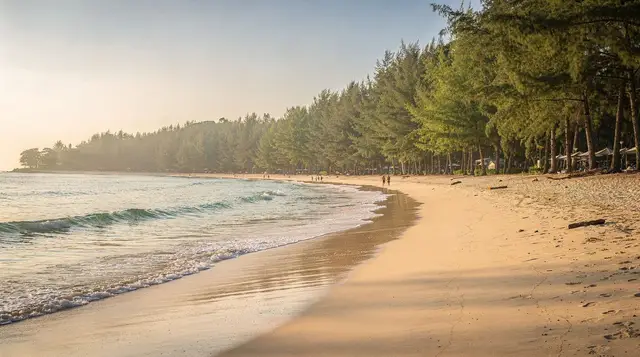
That isolation cuts both ways. The beach itself — a curved half-moon of pale sand backed by a freshwater lagoon and casuarina trees — is one of the cleanest and least crowded stretches of sand on the west coast, and the water is genuinely clear outside monsoon. But the infrastructure that Patong and Karon built up over three decades of mass tourism simply doesn’t exist here. There’s no strip of 24-hour 7-Elevens, no late kitchens, and no fleet of tuk-tuks waiting at every corner. A handful of beachfront restaurants close their kitchens by 9 or 10 pm, and once they do, the beach road goes properly dark except for the lights of the Phuket Yacht Club at the southern end.
If you’re staying in Nai Harn, plan your evenings around that. Bring a scooter or agree an evening taxi fare with your hotel before you need it, because flagging one down on the beach road at 10 pm is not reliable. Most visitors treat Nai Harn as a day trip from Rawai or Kata Beach, or as a one- or two-night stay for people who specifically want the quiet and are happy eating early and heading to bed with the sound of the sea rather than a bar crawl.
The beach and the lagoon
Nai Harn’s defining feature is the lagoon that sits directly behind the sand — a saltwater-fed lake, not a swimming spot itself, but the reason the beach has such an open, green backdrop instead of a solid wall of hotels. Locals jog and cycle the loop road around it in the early morning and at sunset, and there’s a temple, Wat Nai Harn, on its northern shore that anchors a small Sunday market selling clothes, snacks, and secondhand goods to a mostly Thai crowd rather than tourists.
The beach sand itself is soft and pale, sloping gently enough for easy wading in the dry season. Development is restricted because a large stretch of the shoreline and the land around the lagoon is officially protected, which is the other reason Nai Harn has never turned into a second Patong — there’s simply less buildable land right on the water. What construction exists clusters at the southern end near the yacht club and the hillside resorts climbing toward Promthep Cape.
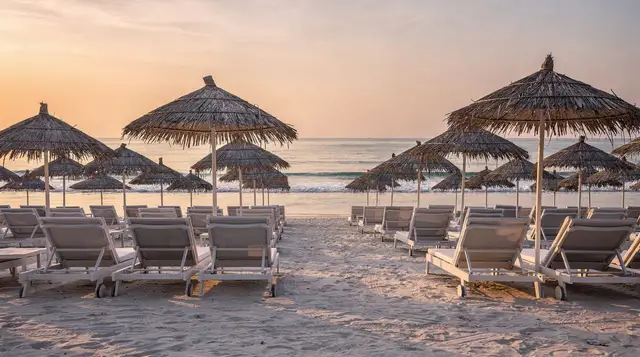
Shade is decent under the casuarina trees along the back of the beach, and sun loungers are available from the handful of beach-adjacent restaurants, usually with a minimum spend rather than a flat rental fee. There’s no long row of identical striped umbrellas the way there is at Karon — read our beach chairs and rules guide if that setup matters to you.
Getting to Nai Harn
From Phuket Airport (HKT): There’s no direct public transport. A private or hotel transfer takes 60–75 minutes and costs roughly 900–1,300 B (about $26–$37) depending on vehicle and operator; a metered airport taxi runs similar. Grab works from the airport but wait times can be long. See our Phuket Airport guide and airport transfers guide before you land.
From Patong or Kata: 25–40 minutes by car over the hill roads. A Grab or metered taxi runs about 400–600 B (about $11–$17) from Patong, less from Kata. Renting a scooter is the cheaper option if you’re comfortable with Phuket’s hill roads — see our scooter rental guide.
From Rawai or Chalong: 10–15 minutes, the closest of the popular beaches. Songthaews (open-sided shared trucks) run from Rawai and Chalong for around 30–40 B (about $1) per person on fixed routes, though schedules thin out after mid-afternoon. A private taxi or tuk-tuk is faster and costs around 200–300 B (about $6–$9).
| From | Transport | Time | Price (one-way) |
|---|---|---|---|
| HKT Airport | Private transfer / taxi | 60–75 min | 900–1,300 B (~$26–37) |
| Patong | Taxi / Grab | 25–35 min | 400–600 B (~$11–17) |
| Kata Beach | Taxi / Grab | 20–30 min | 350–500 B (~$10–14) |
| Rawai | Songthaew | 10–15 min | |
| Chalong | Taxi / tuk-tuk | 10–15 min | 200–300 B (~$6–9) |
Sea conditions and when to actually swim here
Nai Harn faces southwest, which means it takes the brunt of the southwest monsoon between roughly May and October. During that window the surf picks up, currents strengthen, and red flags go up on the days the lifeguards judge it unsafe — take them seriously. Drownings happen most years on Phuket’s west-facing beaches during monsoon, almost always because someone swam past the flags or after the lifeguard post had closed for the evening.
Nai Harn does post lifeguards in season, but coverage is thinner than at Patong or Karon, and there’s no lifeguard presence at all after dark. Our beach safety and riptides guide covers how to read a rip current if you’re caught in one.
From November to April the sea calms down considerably, visibility improves, and this becomes one of the more pleasant swimming beaches on this coast — flat enough for slow laps, clear enough to see your feet in the shallows. It’s also the season sailors favour: Nai Harn hosts an active sailing club, and you’ll often see a scattering of yachts and dinghies moored or racing just offshore, particularly around the Phuket King’s Cup Regatta window in December.
What’s actually worth doing here
Nai Harn isn’t built for organised activities the way Kata or Bang Tao are — there’s no long row of jet-ski and parasail operators. The two things people genuinely come for are the swimming (in season) and the view from the headland just south of the beach, which climbs toward Promthep Cape, Phuket’s best-known sunset viewpoint.
a small-group viewpoint and sunset trekking tour covers this stretch of coastline properly, taking in Promthep Cape and the lesser-known viewpoints around Nai Harn and Ya Nui without you needing your own transport or local knowledge of which trail actually leads somewhere.
If you’d rather see the coastline from the water, a private sunset catamaran cruise departing from nearby Chalong Pier passes this whole southern tip of the island, which is a genuinely different — and calmer — way to watch the sun go down than standing on the headland with the crowds.
For something more specific to the Promthep area itself, a guided twilight tour of Promthep Cape times your visit to avoid the worst of the tour-bus crush, which matters here — Promthep Cape at peak sunset can get surprisingly packed for somewhere this far from the main resort strip.
Anglers based around Rawai and Nai Harn also run day trips out to Racha, and a deep-sea fishing trip toward Racha Island is a reasonable way to spend a day if lounging on the sand for hours isn’t your idea of a holiday.
Where to eat and where you can’t
Food options thin out fast once you’re away from the two or three beachfront restaurant clusters. The northern end near the lagoon has a handful of seafood places with sand-floor seating, reasonably priced for the west coast — expect 150–300 B (about $4–9) for a rice or noodle dish, more for fresh seafood by weight. The Sunday market by Wat Nai Harn is a good cheap-eats option if your visit lines up with it, with skewers, roti, and som tam stalls aimed at locals rather than tourists.
What you will not find: a 7-Eleven directly on the beach road (the nearest is a short drive inland), late-night kitchens, or the density of restaurant choice you’d get in Rawai or Chalong, both a short taxi ride away and worth the trip if you want more variety for dinner. If you’re staying multiple nights and want walkable evening options, weigh that against Nai Harn’s quiet before booking — see where to stay in Phuket for how the beaches compare on this exact trade-off.
Nai Harn compared to the beaches around it
| Beach | Vibe | Nightlife | Crowds |
|---|---|---|---|
| Nai Harn | Quiet, lagoon-backed, sailing | Almost none | Low |
| Rawai | Local, seafood-market focused | Minimal | Low–moderate |
| Kata Beach | Mid-size resort beach | Moderate | Moderate–high |
| Patong | Full resort strip | Constant | High |
If Nai Harn’s quiet turns out to be more than you wanted after a day, Kata Beach and Karon are the nearest beaches with a real evening scene, both under 30 minutes away. For a similarly calm alternative with a different character — flat sand, no lagoon, closer to Chalong Pier — see Rawai.
Where to stay around Nai Harn
Accommodation clusters in two distinct pockets. The hillside above the southern end of the beach, climbing toward Promthep Cape, holds a run of mid-range and upscale resorts with sea views over the lagoon and bay — a genuine selling point here, since few Phuket beaches offer a hillside vantage over both a beach and a freshwater lagoon at once. Closer to the sand and the lagoon’s northern shore, guesthouses and smaller hotels sit at lower prices, generally without the view but within easy walking distance of the beach and the Sunday market.
What almost nowhere around Nai Harn offers is a big-brand beachfront tower directly on the sand, the way you’d find at Karon or Patong — the protected land around the lagoon has kept that kind of large-footprint development off the immediate shoreline. If ground-floor beachfront access matters more to you than the view or the quiet, weigh that against what Nai Harn is actually offering before booking multiple nights here. Our where to stay in Phuket guide breaks down how Nai Harn compares with the other bases on this coast for exactly this kind of trade-off.
Whichever pocket you choose, budget extra time for evening logistics. Few properties are within a genuine walking distance of more than one or two restaurants, so agree a return taxi time with your driver rather than assuming you’ll find one waiting outside a restaurant at 9 pm.
A sample day at Nai Harn
A realistic day here starts early, before the heat builds: a walk or run around the lagoon loop while it’s still cool, then breakfast at one of the lakeside cafés if your hotel doesn’t already have you covered. Late morning is for the beach itself — swimming if the flags are green, or a slow walk along the sand if you’d rather stay dry. By early afternoon, when the sun is highest and shade is at a premium, many visitors retreat to a beachfront restaurant for a long lunch rather than push through the hottest hours on open sand.
Late afternoon is when Nai Harn’s real advantage kicks in: the short walk or drive up toward Promthep Cape for sunset, ahead of or instead of the coach-tour crowds that build there closer to dusk. Dinner back at one of the beach’s handful of restaurants wraps up the day — and given how early the kitchens here close, it’s worth eating by 8 pm rather than assuming you can push dinner later the way you might in Patong.
Frequently asked questions about Nai Harn beach
Is Nai Harn safe for swimming?
In the dry season (November–April), yes, and it’s one of the calmer beaches on this coast. During the southwest monsoon (roughly May–October) the surf and currents pick up and red flags go up on rough days — don’t swim past them, and don’t assume a lifeguard is on duty after late afternoon.
How do I get to Nai Harn without a car?
Songthaews run from Rawai and Chalong for a few dozen baht but stop in the late afternoon. Outside those hours, or from further away, a Grab or metered taxi is the reliable option.
Is there nightlife at Nai Harn?
Almost none. Most restaurants close by 9–10 pm and there are no beach bars or clubs. It’s a beach for people who want quiet evenings, not a base for anyone chasing Phuket’s nightlife.
Can I walk to Promthep Cape from Nai Harn?
Yes, there’s a coastal path and road connecting Nai Harn to the Promthep Cape viewpoint, roughly a 20–30 minute walk uphill, or a short taxi ride if you’d rather not do it in the heat.
Is Nai Harn good for families?
The lagoon side is calm and pleasant for a stroll, and the beach itself is fine for kids in the dry season, but the lack of shallow, gently sloping sand in some sections and the seasonal currents mean Karon or Bang Tao are generally easier choices for young children.
What’s the closest beach with more restaurants and shops?
Rawai and Chalong, both 10–15 minutes away, have significantly more food options, small shops, and the Rawai seafood market for anyone who wants variety without leaving the quiet south of the island entirely.
Is there ATM and shop access at Nai Harn?
A small number of ATMs and minimarts sit on the road just back from the beach, but nowhere near the density of Rawai or Chalong. Withdraw what you need before settling in for the day rather than relying on finding a machine right on the sand.
Can I sail or take a boat trip from Nai Harn?
Yes — Nai Harn hosts an active sailing club and is a genuine base for dinghies and yachts, especially in the dry season around the Phuket King’s Cup Regatta window in December. For a guided trip rather than sailing yourself, the sunset catamaran and viewpoint tours covered above both operate from this stretch of coast.