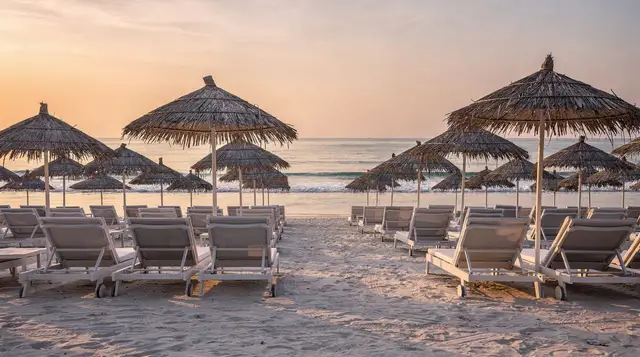
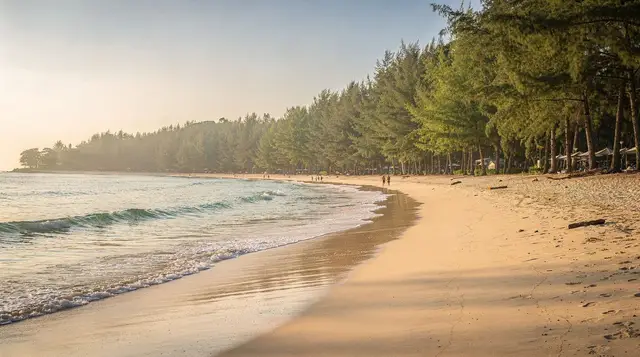
Kata is really two beaches: Kata Yai, the main and larger stretch, and the smaller, more sheltered Kata Noi just over the headland to the south. Both share the same trait that defines this stretch of coast — a wet-season swell that surfers plan their trip around and casual swimmers should treat with respect.
Who Kata actually suits
Kata suits surfers, first outright: it has Phuket’s most reliable beginner-to-intermediate break, and a cluster of surf schools sit right on the sand ready to rent boards or run lessons. It also suits younger travellers and families who want a beach with a genuine village feel — Kata’s centre is walkable, with a mix of backpacker guesthouses and mid-range resorts rather than Patong’s high-rise density. Kata Noi in particular suits couples wanting a quieter cove within a short walk or ride of Kata Yai’s restaurants.
It suits less well swimmers who want calm water outside the November-to-April window, and anyone hoping for Bang Tao-style beach-club luxury — Kata’s food and drink scene leans casual rather than upscale, Mom Tri’s Kitchen aside. If flat, easy swimming is the priority, Bang Tao/Laguna or Karon are worth comparing via Patong vs Kata vs Karon.
Timing matters more at Kata than at most of the other beaches on this list, since the beach genuinely serves two different kinds of trip depending on the month. A surf-focused visitor booking for December expecting wet-season waves will be disappointed, just as a swimmer booking for August expecting calm, flat water will be surprised by the break. Checking best time to visit Phuket against your specific goal for this beach is worth the two minutes it takes.
What a day at Kata looks like
Kata Yai’s main stretch has a relaxed, slightly younger energy than Karon or Patong — surf shops with boards racked out front, cafés doing all-day breakfasts, and a beach that stays reasonably lively without tipping into Patong’s intensity. Surfers tend to be out early, from sunrise through mid-morning before the wind picks up, and again in the late afternoon; if you want to watch rather than surf, those windows are the best time to see the break working. Kata Noi, a five-to-ten-minute walk or short ride over the headland, is smaller, more sheltered by the surrounding hills, and noticeably quieter — a common choice for a calmer afternoon after a morning surf lesson on the main beach.
The area between Kata and Karon, sometimes referred to together as Kata-Karon, has its own small collection of shops, spas and restaurants along the connecting road, useful if you’re staying in one and want variety without a long trip.
Where to stay in Kata
Kata’s accommodation ranges from backpacker guesthouses and mid-range beachfront hotels on Kata Yai to a handful of upscale hillside properties toward Kata Noi with sea views over the headland — Villa Royale, home to Mom Tri’s Kitchen, is the best known of these. Prices sit below Patong’s high-rises for a comparable standard, and well below Bang Tao’s resort rates. High season (December-January) and the Christmas-New Year period push rates up considerably; outside of that and July-August, Kata is generally good value. See where to stay in Phuket for the island-wide comparison.
A brief history
Kata’s surf reputation is relatively recent by Phuket standards — the beach was a quieter fishing and farming area before tourism arrived in force, and its surf culture built up gradually from the 1990s onward as visiting surfers and a handful of local operators recognised the consistency of the wet-season break. That surf-town identity now sits alongside a longer-established beach-resort scene, which is part of why Kata feels like it has two overlapping personalities: a laid-back surf village by day and a fairly conventional beach resort by night.
Packing and practical notes
If surfing is part of the plan, reef shoes are worth packing for the rockier sections near Kata Noi, and rash guards help with both sun and board-related friction for beginners. Outside the surf season, standard beach kit — reef-safe sunscreen, a hat, a dry bag for valuables on the sand — covers it. Cash remains the norm at surf shacks and smaller restaurants; cards are generally accepted at hotels and larger beachfront places. See Phuket’s packing list for more.
Sea conditions and safety, by season
November to April: the swell drops and Kata Yai in particular becomes a calmer, family-friendly swimming beach, similar to the rest of the west coast in dry season.
May to October: this is Kata’s surf season, and the same swell that makes the waves means real rip currents and shore break for anyone not surfing. Kata sits on the same stretch of west-coast drowning statistics as Patong and Karon — red flags go up when lifeguards judge conditions unsafe, and swimming past them is exactly how tourists drown here most years.
Kata Noi is somewhat more sheltered by its headland but is not automatically safe just because it’s smaller and calmer-looking; check the flag there too. If you’re pulled out by a current, swim parallel to shore rather than straight back in, and don’t panic-swim against it. Full detail in Phuket’s beach safety and riptide guide and the monsoon season guide.
Getting to Kata
From Phuket Airport (HKT): Kata is roughly 45km from the airport, around 50-70 minutes depending on traffic. The airport’s fixed-price taxi desk charges approximately 800-950 baht (23-27 USD). A pre-booked private transfer costs about the same with a fixed price agreed in advance — see Phuket airport transfers and the HKT airport guide for the shared-minibus option at around 200 baht (6 USD) per person.
From other beaches: Karon is a 5-10 minute, 100-150 baht (3-4 USD) hop over the connecting headland road. Patong is 20-25 minutes and 250-350 baht (7-10 USD). Bang Tao, Surin or Kamala run 35-45 minutes and 450-600 baht (13-17 USD), crossing through Phuket Town or over the island’s central hills. As elsewhere, tuk-tuks charge noticeably more than metered taxis or Grab for the same trip — see taxis, tuk-tuks and Grab in Phuket.
Where to eat and drink
Kata’s signature restaurant is Mom Tri’s Kitchen, part of the Villa Royale property on the headland toward Kata Noi — a genuine fine-dining option with an ocean view, well above street-food prices (expect 800-1,500 baht/23-43 USD per main). For something between that and a beach shack, Boathouse Wine & Grill on Kata Yai’s beach road is a long-standing, well-reviewed choice for seafood and wine, roughly 400-800 baht (11-23 USD) per main.
On the more casual end, Kata’s back streets have inexpensive Thai noodle and rice shops from 100-180 baht (3-5 USD), and a seasonal weekend night market sets up with street-food stalls in high season — check current dates locally, as it doesn’t run year-round. See Phuket’s street food guide for the island-wide picture.
What’s actually worth booking
Surfing is Kata’s headline activity, but the beach also sits close to some of Phuket’s best-known cultural sights.
- Beginner surf lessons: boards and instruction right on Kata Yai, best May-October when the swell is up: Surf lesson for beginners at Kata Beach
- Private surf lessons: for a faster learning curve or intermediate coaching: Private surfing lessons at Kata Beach
- Simon Cabaret: Kata is the closest beach to Phuket’s best-known cabaret show, a short taxi ride away: Simon Cabaret show admission
- Big Buddha and Wat Chalong: both sit inland from Kata, easily combined into a half-day tour: Big Buddha, Wat Chalong and Old Town guided tour
For more on the wider surf scene, see surfing in Phuket, and for other water sports options, kitesurfing in Phuket and sea kayaking in Phuket.
Traps to know about
Surfboard rental deposits work similarly to Patong’s jet-ski scam on a smaller scale — some independent operators claim pre-existing ding damage when a board is returned. Renting through a school running lessons (rather than a bare board-rental stand) reduces this risk, and photographing the board beforehand is cheap insurance either way; see Phuket’s scams to avoid.
Beach chairs and umbrellas follow the same pay-to-sit system as the rest of the west coast, typically 100-150 baht (3-4 USD) — see Phuket’s beach chair rules. Tuk-tuks running the Kata-Karon-Patong loop are a common overcharge target for tired beachgoers in the evening; agree the fare first or use Grab.
Beyond the beach
Kata sits within easy reach of Phuket’s Big Buddha and Wat Chalong, both inland and reachable within 20-30 minutes by taxi or scooter — a common half-day pairing with a Kata beach morning. A weekend market sets up seasonally in Kata’s centre with clothing, souvenirs and street food, where bargaining is normal — see bargaining in Phuket’s markets. For a rainy-day fallback during monsoon, rainy day activities in Phuket covers indoor options within reach of this side of the island.
Families and solo travellers
Kata suits families reasonably well outside monsoon, with a gentler slope than Karon in most conditions and a village-like centre that’s easy to navigate with kids in tow. During the May-October surf season, families with young children may find Karon’s calmer northern stretch or a resort pool at Bang Tao a more relaxed choice than Kata’s working surf break. For solo travellers, Kata’s daytime surf and café culture makes it an easy, low-pressure base — quieter and less transactional after dark than Patong, without being as isolated as some of the smaller beaches further south. See Phuket with kids and Phuket solo travel for more.
More on Kata’s surf scene
Kata’s break works best on a mid-to-high tide with a moderate southwest swell, conditions that show up most reliably from June through September. Surf schools rent boards by the hour (roughly 100-200 baht/3-6 USD) alongside guided lessons, and several offer multi-day packages for visitors trying to progress beyond the basics during a single trip. Outside the surf season, the same schools often shift toward stand-up paddleboarding or simply close for the quieter months — check that a specific school is operating before planning a trip around it in the shoulder months. See surfing in Phuket for the island-wide surf calendar, including how Kata compares with Kalim and Kamala’s smaller breaks.
More on traps and etiquette
Beyond board rental deposits, Kata sees the same seafood-by-weight pricing issue found elsewhere on this coast — confirm the per-100g price before ordering rather than after the fish is on the grill. Beach photographers who approach with an offer to take photos and print them on the spot are common on Kata’s sand; agree a price before any photos are taken; if none is agreed, you’re not obligated to pay for images you didn’t ask for. General guidance in Phuket’s scams to avoid and first-time-in-Phuket mistakes covers the rest.
How Kata compares to its neighbours
| Kata Beach | Karon | Patong | |
|---|---|---|---|
| Best known for | Surfing, village feel | Wide open sand | Nightlife, shopping |
| Nightlife | Casual, low-key | Limited, quiet | Extensive, late |
| Typical price level | Mid-range | Mid-range | Wide range |
| Best for | Surfers, couples, younger travellers | Families, first-timers | Nightlife-focused stays |
| Notable sub-area | Kata Noi (quieter cove) | Karon Circle | Bangla Road |
As with any table like this, the honest reading is that none of these three beaches is strictly “best” — they suit different priorities, and the right answer depends more on what you want from a specific day than on the beach’s overall reputation. Patong vs Kata vs Karon covers the comparison in more depth.
Frequently asked questions about Kata Beach
Is Kata Beach good for beginners at surfing?
Yes — Kata’s break is widely considered Phuket’s best for beginners, with multiple schools offering lessons and board rental directly on the sand, best from roughly June to September.
What’s the difference between Kata Yai and Kata Noi?
Kata Yai is the main, longer beach with most of the restaurants, shops and surf schools. Kata Noi, a short walk over the headland, is smaller, quieter and more sheltered, popular for a calmer afternoon.
Is Kata Beach walkable?
Kata’s centre is compact and easily walkable, with Kata Noi reachable on foot in 10-15 minutes. A taxi, Grab or scooter is more practical for trips to Karon, Patong or inland sights like Big Buddha.
Is Kata Beach expensive?
Generally mid-range — cheaper than Bang Tao’s resort scene, similar to or slightly above Karon, and below Patong’s peak beachfront pricing outside of Mom Tri’s Kitchen and similar upscale options.
Does Kata Beach have jet skis or other motorised water sports?
Less prominently than Patong or Karon — Kata’s water-sports scene is built around surfing rather than motorised activities, though some operators offer them seasonally. If jet skiing specifically is the priority, Patong has the widest choice of operators on this coast.
Is Kata Noi worth visiting separately from Kata Yai?
Yes, if a quieter cove appeals — Kata Noi has a different, calmer atmosphere, fewer vendors and a smaller crowd, and it’s an easy walk or short ride from Kata Yai, so it’s rarely worth skipping entirely even on a short stay, even if you’re only passing through for an afternoon.
Where this fits in a trip
Kata pairs naturally with Karon as a one- or two-day base, or works as a full-week stay for surfers timing a monsoon trip — see a 7-day Phuket itinerary or the more surf-focused Phuket diving week itinerary for adjusting activities by season. How many days to spend in Phuket and Phuket’s neighbourhoods explained help place Kata against the rest of the island before you commit to a base.