Kitesurfing in Phuket
Where and when can you kitesurf in Phuket?
Nai Yang, on the northwest coast, works roughly April through October when the southwest monsoon brings onshore wind. Rawai, on the south coast, works the opposite months, roughly November through March, when the northeast monsoon takes over — the two spots almost never work at the same time.
Two coasts, two seasons, rarely both at once
Kitesurfing in Phuket isn’t a single-spot, single-season activity the way surfing at Kata roughly is. It’s split across two beaches on opposite sides of the island that catch opposite wind systems, which means the answer to “when should I kitesurf in Phuket” depends entirely on which beach you’re asking about. Get this wrong and you can show up at Nai Yang in January expecting wind and find flat, glassy water — the season you want is on the other side of the island at that time of year.
Nai Yang: green-season kiting on the northwest coast
Nai Yang is Phuket’s main kitesurf beach during the green season, roughly April through October, when the southwest monsoon delivers consistent onshore wind across a long, shallow, sandy beach with plenty of room to launch and land without threading between sunbathers and beach chairs the way a busier beach would require. Wind here tends to be strongest and most reliable from June through September, tapering off toward October as the monsoon eases.
Nai Yang sits within Sirinat National Park, which matters practically: kiting zones are informally understood among local riders and schools, but they’re not marked with the same permanence as a purpose-built kite beach, and the shallow reef flat that extends out at low tide changes what’s actually rideable through the tide cycle. If you’re kiting independently rather than through a school, check tide times and talk to whoever’s already out before rigging up — the safe launch window shifts through the day.
Rawai: the opposite-season option in the south
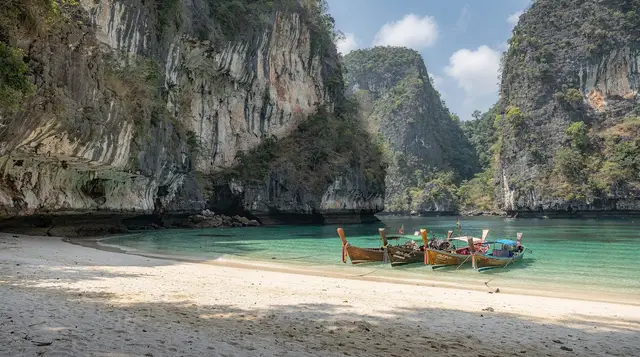
Rawai, on the island’s south coast, catches the wind Nai Yang misses — the northeast monsoon, roughly November through March, the same months that are Phuket’s driest, calmest tourist high season everywhere else on the island. This is the more useful spot for anyone visiting during the standard November–April travel window who still wants to kite, since Nai Yang is largely flat during exactly those months. Rawai’s launch area is smaller and rockier than Nai Yang’s long sand beach, with longtail boats moored close to shore and a reef that’s a real hazard at low tide — riders need to be more precise about timing and launch zone here than at the wide-open Nai Yang beach.
Why the seasons are opposite, briefly
Phuket sits between two monsoon systems that alternate through the year: the southwest monsoon (roughly May–October) and the northeast monsoon (roughly November–March). Each coast faces a different direction, so each one catches wind from a different monsoon — the northwest-facing Nai Yang gets exposed to the southwest monsoon’s push, while the south-facing Rawai catches the northeast monsoon instead.
It’s the same mechanism that makes surfing in Phuket a wet-season activity on the west coast, just playing out differently for wind versus swell. For the fuller picture of how the two monsoon systems shape the island’s weather generally, see the Phuket monsoon season guide and Phuket weather month by month.
Gear, lessons and what a session costs
Kitesurfing has a steeper and more genuinely dangerous learning curve than most beach activities in Phuket — a kite generates real pulling force, and an uncontrolled kite near other beachgoers, boats or rocks is a hazard to more than just the rider. This isn’t an activity to self-teach with a rented kite and a YouTube video.
IKO-certified instruction is the standard route: a beginner course typically runs over several days (often structured as 3, 6 or 9 hours split across sessions), starting with kite control on the beach before ever getting in the water, and running roughly 3,500–5,000 B ($100–142) per hour of instruction, or a multi-day package in the 12,000–20,000 B ($340–570) range. Equipment rental for already-competent kiters runs roughly 1,500–2,500 B ($43–71) per session, though availability depends on the season — gear and schools genuinely relocate or scale down between Nai Yang and Rawai as the wind shifts.
Skill level and who this suits
Complete beginners should expect several sessions before independently riding, not a single afternoon. If you’ve kited elsewhere and are confident and self-sufficient, renting gear for a session at whichever beach is in season is straightforward; if you’re new to the sport, budget real time and a proper course rather than trying to compress it into one day of a busy trip. Kitesurfing rewards a longer stay more than most Phuket activities — it’s a poor fit for someone with one free afternoon who’s never held a kite bar before.
Safety specifics that matter here
- Check which season it actually is before travelling to either beach specifically to kite — showing up at the wrong beach in the wrong month means no wind, not just less wind.
- Respect the reef at both spots. Low tide exposes reef flat at Nai Yang and rocky shallows at Rawai; launching or landing over exposed reef risks both equipment damage and cuts.
- Watch for other water users. Longtail boats, swimmers and — at Nai Yang — occasional aircraft noise from the nearby airport flight path are all part of the shared space; give other beach users genuine room.
- Don’t kite alone as a beginner. A school or at minimum an experienced local rider who knows the specific launch and landing zones is worth the cost, especially at Rawai’s tighter, rockier setup.
- General water safety still applies. Even outside a kite session, check conditions before swimming — see Phuket beach safety and riptides for what the flag system means at Phuket’s beaches generally.
Nai Yang vs Rawai at a glance
| Nai Yang | Rawai | |
|---|---|---|
| Season | April–October (southwest monsoon) | November–March (northeast monsoon) |
| Coast | Northwest | South |
| Beach type | Long, sandy, open | Smaller, rockier |
| Hazards | Shallow reef flat at low tide | Rocks, moored longtail boats, reef |
| Best for | Beginners (more space to learn) | Riders comfortable with a tighter launch zone |
| Tourist season overlap | Overlaps Phuket’s quiet, rainy low season | Overlaps Phuket’s busy, dry high season |
If you’re choosing where to stay partly around this, Nai Yang is also one of Phuket’s quieter beaches generally, worth knowing whether or not kiting is the main draw.
Planning a trip specifically to kite
Since the two spots don’t overlap, decide your priority before booking flights. If your travel dates are fixed to Phuket’s conventional November–April high season, Rawai is the realistic option — see best time to visit Phuket for how this lines up against everything else the high season is good for. If you have more flexibility and specifically want the greener, quieter, cheaper months, Nai Yang’s April–October window is worth building a trip around; Phuket in low season covers what else changes about the island during those months, beyond the wind.
Other ways to get on the water regardless of wind
If the wind isn’t cooperating at either beach when you’re there, jet skis in Phuket and parasailing and flyboard in Phuket don’t depend on natural wind at all, and calmer days are actually better for sea kayaking in Phuket than a windy kite day would be.
Checking wind before you commit a day to it
Because both spots are seasonal rather than reliably windy every single day within their window, it’s worth checking a wind forecast app the morning of rather than assuming the calendar alone guarantees a session. Local schools and independent riders generally watch the same forecasts and tend to be out on the water (or visibly not) by mid-morning on any viable day — arriving at the beach and seeing whether kites are already up is a reasonably reliable low-tech check if you haven’t looked at a forecast yourself. Wind at both Nai Yang and Rawai tends to build through the morning and can ease off in the early afternoon, so a late-morning session is often the safer bet than waiting until after lunch.
Course packages vs single sessions
Schools generally offer both single-session rental (for already-competent riders) and structured multi-day beginner packages, and the pricing reflects a real difference in what you’re getting. A package typically bundles kite control, body-dragging, water starts and independent riding across several sessions with the same instructor, which matters because kitesurfing genuinely doesn’t compress well into a single afternoon the way a surf lesson can.
Riders who’ve learned elsewhere and are simply looking for a few sessions on unfamiliar wind and water should still budget for at least one supervised orientation session with a local instructor before going out alone — local hazards (the reef at Nai Yang, the rocks and boat traffic at Rawai) aren’t obvious from a forecast app, and a local instructor’s five-minute site briefing is worth more than it costs.
Choosing where to stay if kiting is the priority
Since the two spots don’t overlap in season, where you base yourself matters more for a kitesurf-focused trip than for most other Phuket activities. Staying near Nai Yang makes sense for a green-season trip, with the added benefit of being close to the airport for an easy arrival or departure day. Staying near Rawai suits a high-season trip and puts you closer to the island’s south coast dive and boat-trip hubs as well, worth factoring in if kiting is one activity among several rather than the sole reason for the trip.
Why Phuket isn’t marketed as a major kite destination
Compared to dedicated regional kite hubs elsewhere in Southeast Asia that run consistent wind for the better part of a year, Phuket’s split, seasonal setup is a genuine limitation, and it’s honest to say kiting here is a strong secondary activity for visitors already coming for other reasons rather than a standalone reason to choose Phuket over a purpose-built kite destination.
What it does offer is real, teachable wind on two different beaches at two different times of year, both close enough to the island’s other attractions that a kite session fits naturally into a broader trip rather than requiring a dedicated kite-focused holiday. Riders who’ve kited at bigger dedicated destinations shouldn’t expect Phuket to match that scale or reliability; riders looking to try the sport for the first time, or fit a few sessions into an otherwise varied Phuket trip, will find both spots genuinely workable within their respective windows.
Combining kiting with other Phuket plans
Because both kite seasons are tied to specific months, it’s worth checking your actual travel dates against the Nai Yang/Rawai calendar before assuming kiting will be part of the trip at all — a fixed one-week visit in, say, February will only work for Rawai, while a fixed visit in August only works for Nai Yang. If your dates fall in a genuine gap between the two seasons (roughly late October to early November, as one monsoon hands off to the other), don’t count on reliable wind at either spot; that transitional window is a reasonable time to plan around other water sports instead, or simply treat kiting as a bonus if conditions happen to cooperate rather than the trip’s centrepiece.
A note on why this page doesn’t push a specific tour
Unlike most activities covered on this site, there isn’t currently a bookable kitesurf tour or lesson package listed in our tour catalogue for either Nai Yang or Rawai — the honest reason this guide points you toward checking with local schools directly rather than a specific pre-booked package. That’s a deliberate choice: better to give accurate, useful information about where and when to kite than to attach an unrelated water-sports booking just to have a link on the page. If that changes, this guide will be updated with a direct booking option.
Talking to other riders on the beach
Both Nai Yang and Rawai are small enough scenes that the riders and instructors on the beach on any given day generally know current local conditions better than any app or guide, including this one. Arriving, watching for a few minutes, and asking a friendly question of whoever is already rigged up is a normal, welcomed part of the culture at both spots rather than an intrusion — kite communities everywhere tend to be more open to newcomers asking sensible questions than most other water sports scenes, partly because a well-informed newcomer is safer for everyone sharing the same limited launch space.
Frequently asked questions about kitesurfing in Phuket
Can beginners learn to kitesurf in Phuket?
Yes, through IKO-certified schools at whichever beach is in season. Expect several sessions before riding independently — it’s not a one-afternoon activity for someone who’s never held a kite before.
Is Nai Yang or Rawai better for kitesurfing?
Neither is objectively better — they work in opposite seasons. Nai Yang (April–October) has more space and suits beginners better; Rawai (November–March) is tighter and rockier but aligns with Phuket’s conventional high-season travel dates.
Can I kitesurf in Phuket during the tourist high season?
Yes, at Rawai on the south coast, which catches wind from the northeast monsoon during roughly the same months as Phuket’s dry, busy high season. Nai Yang is largely flat during this period.
Do I need my own kite equipment?
No — rental is available at both beaches in season, though availability shifts as schools and gear relocate between the two spots through the year. Bringing your own gear only makes sense if you have strong personal equipment preferences.
Is kitesurfing dangerous for beginners in Phuket?
It has a real learning curve and genuine risks around kite control, other beach users and reef hazards at both spots. Proper certified instruction, not self-teaching, is the standard and safer route.
Is there kitesurfing in Phuket year-round at one single beach?
Not reliably. Each beach has a defined seasonal window tied to a specific monsoon; outside that window, expect flat or unreliable wind at that particular spot.
tours.water-sports
Verified deep-linked GetYourGuide tours. Book through these links and we earn a small commission at no cost to you.
These are our own photographs of Phuket, not the operator's pictures of this tour — open the tour page to see those.