A national park beach that happens to be near the runway
Nai Yang is the main beach inside Sirinat National Park, the protected strip of coastline that runs along Phuket’s northwest shoulder and takes in Nai Yang, Mai Khao, and the pine-backed dunes between them. Because it sits inside a national park rather than a normal municipal beachfront, large-scale resort construction directly on the sand has been restricted for decades, which is the main reason Nai Yang looks nothing like Patong or Karon despite being on the same island and, these days, only a short drive from an international airport.
That airport proximity is Nai Yang’s other defining fact. Phuket Airport (HKT) sits about 10–15 minutes away by road, close enough that this is a genuinely practical choice for a first or last night of a trip, especially with an early departure. It’s also close enough that you’ll hear aircraft on approach or departure through the day, though Nai Yang is set back further from the runway threshold than Mai Khao, so the noise is noticeably less intense here than on Mai Khao’s northern stretch.
What you get for accepting that trade-off is a shaded, casuarina-backed beach with a real local character: a row of simple restaurants building right onto the sand, a national park visitor centre and campground, and a beach that’s genuinely popular with Thai families on weekends rather than being purely a tourist strip.
Sirinat National Park, in practice
Sirinat National Park covers roughly 22 square kilometres of coastline and coastal forest, protecting the beach, dune vegetation, and a stretch of seagrass and reef offshore. For most visitors the park designation is mostly invisible day to day — the beach itself is free and open, and there’s no ticket gate at the main entrance the way there is at some of Thailand’s inland parks. Where it matters more is around the wildlife: turtle nesting sites (shared with neighbouring Mai Khao) are protected, sections of the dune forest are off-limits to development, and campers using the official campground need a small park fee.
If you want to go beyond the beach itself, the park’s forest and mangrove edges are worth a look — the mangrove creek system near the park’s southern boundary is one of the more accessible patches of that ecosystem on this side of the island. an ATV tour through the mangrove and jungle trails near here covers ground you wouldn’t easily reach on foot, ending at one of the quieter hidden beaches along this stretch of coast.
For a slower version of the same idea, a half-day countryside cycling tour with lunch runs through the rural back roads inland from Nai Yang and Sirinat — rubber plantations, small villages, and rice paddies that most beach-only visitors never see. If you’d rather cover more ground on two wheels off-road, a guided hidden-trails biking adventure is a mountain-bike-oriented option through similar terrain.
The beach and the restaurants
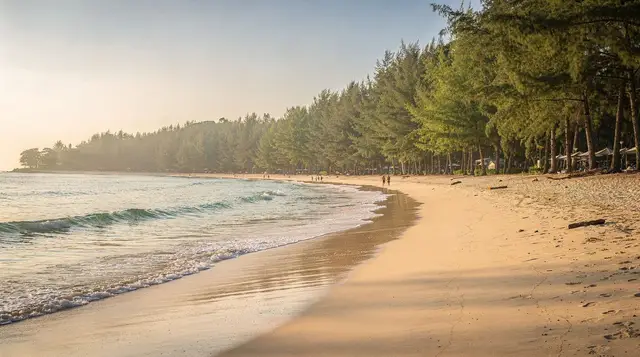
Nai Yang’s beach is long, straight, and shaded well beyond what you’d find at most Phuket beaches — a proper band of casuarina pines runs along the back of the sand for most of its length, which makes it one of the more comfortable beaches to spend a full afternoon on without constantly retreating to a rented umbrella. The sand itself is a slightly coarser, more golden tone than the fine white sand further south, and the sea shelves gradually, making for easy wading in calm conditions.
The real draw for a lot of visitors is the row of beachfront seafood restaurants that build their tables and chairs directly onto the sand, a setup you don’t get at the bigger resort beaches, where restaurants sit back behind a road or a strip of hotel property. Expect grilled fish and prawns sold by weight, standard Thai plates in the 100–200 B (about $3–6) range, and fresh seafood dishes running higher depending on what’s in season and the size of your catch — always confirm the price per weight before you order anything sold this way. Evenings here are genuinely pleasant: tables in the sand, a view straight out over the water, and none of the beach-bar noise of the resort strips.
Getting to Nai Yang
From Phuket Airport (HKT): 10–15 minutes by road, the shortest airport run of any beach on this list. A taxi or Grab costs roughly 250–400 B (about $7–11); a private airport transfer with meet-and-greet is worth arranging if you’re landing late or want someone tracking your flight in case of delays. See our full Phuket Airport guide for terminal layout and arrival logistics.
From Patong or the west-coast resort strip: About 30–40 minutes, mostly along the coast road past Bang Tao and Layan Beach. Taxi or Grab runs roughly 500–700 B (about $14–20).
From Phuket Town: Around 30 minutes via the airport road, similarly priced to a trip from Patong.
| From | Time | Price (one-way) |
|---|---|---|
| HKT Airport | 10–15 min | 250–400 B (~$7–11) |
| Bang Tao / Laguna | 15–20 min | 350–500 B (~$10–14) |
| Patong | 30–40 min | 500–700 B (~$14–20) |
| Phuket Town | ~30 min | 450–600 B (~$13–17) |
There’s no reliable public songthaew route running this far north on a fixed schedule, so budget for a taxi, Grab, or a rented scooter — see our scooter rental guide and getting around Phuket guide if you’ll be based up here for more than a day.
Sea conditions and wind
Nai Yang faces the same southwest monsoon exposure as the rest of Phuket’s west coast, so the same seasonal rule applies: calmer, clearer water from roughly November to April, rougher surf and stronger currents from May to October, with red flags going up on unsafe days. Treat those flags as a hard rule, not a suggestion — see our beach safety and riptides guide for how to spot and escape a rip current if you’re ever caught in one.
What Nai Yang has that most Phuket beaches don’t is a genuine wind-sports season. From roughly December to March, steady northeast winds make this stretch of coast, along with neighbouring Layan and Nai Thon, one of the better spots on the island for kitesurfing — see our kitesurfing in Phuket guide for where lessons and equipment rental are actually based, since Nai Yang itself has limited on-beach rental infrastructure compared with the dedicated schools further along the coast.
What’s around Nai Yang
Beyond the beach and the park, Nai Yang doesn’t offer much in the way of shopping or organised nightlife, and that’s largely by design — it’s a beach for people who came for the quiet, not for a base with a lot to do after dark. The nearest real restaurant and shop density is at Bang Tao, about 20 minutes south, home to the Boat Avenue and Porto de Phuket retail strips if you want an evening out with more variety.
For day-trip options from a Nai Yang base, Phuket Old Town is roughly 40 minutes away and worth the drive for its Sino-Portuguese shophouse streets and food scene, and Layan Beach and Nai Thon are close enough for easy beach-hopping if you want to compare the north coast’s quieter options in one trip.
Where to stay around Nai Yang
Accommodation at Nai Yang splits mainly into two types: a scattering of mid-range and boutique hotels within walking distance of the beach and its restaurant row, and a few larger resorts set slightly further back given the national park’s limits on beachfront construction. Because Nai Yang sits inside a protected area, you will not find the density of choice you’d get at Bang Tao or Patong — booking ahead in high season matters more here than at beaches with dozens of interchangeable options.
The airport proximity makes Nai Yang a genuinely practical choice for splitting a longer trip: a few nights on a livelier beach further south, then a final night at Nai Yang before an early flight, without the stress of an unpredictable airport-road drive on departure morning. If that’s your plan, our Phuket Airport guide has the terminal layout and check-in timing to plan around.
A sample day at Nai Yang
Mornings here suit an early walk along the shaded beach before the heat sets in, followed by breakfast at one of the sand-floor restaurants if they’re open, or a coffee run into the small parade of shops back from the beach road. Late morning through early afternoon is best spent either in the water, if the flags are green and it’s the dry season, or exploring inland — the mangrove and cycling routes covered above are a genuinely different way to spend a few hours compared with sitting on sand.
Evenings are Nai Yang’s strongest card: a table in the sand at one of the beachfront seafood restaurants, fresh catch grilled to order, and a view over the water with none of the resort-strip noise. If you want more choice than the beach itself offers, a short drive to Bang Tao opens up a wider range of restaurants and a proper evening out, before heading back to Nai Yang’s quiet for the night.
Packing and practical notes
Bring cash — while some restaurants and shops take cards, smaller stalls and market vendors around Nai Yang generally expect baht. There’s no dense ATM network directly on the beach road, so withdraw what you need before settling in. Insect repellent is worth having given the proximity to mangrove and forest edges, particularly around dusk. If you’re visiting in the December–March wind season and plan to try kitesurfing, book lessons in advance through an established operator — see our kitesurfing in Phuket guide — rather than expecting to arrange it on the day, since equipment and instructor availability is more limited here than at Phuket’s larger water-sports hubs.
Frequently asked questions about Nai Yang beach
Is Nai Yang good for a night before an early flight?
Yes — it’s the closest of Phuket’s quiet beaches to the airport, roughly 10–15 minutes by road, which makes it a practical choice if you have an early departure and don’t want to gamble on airport-road traffic from further south.
Do I need to pay to enter Sirinat National Park at Nai Yang?
The beach itself is free to access. A small fee applies only if you’re using the official national park campground or certain facilities; there’s no general entry ticket for the beach.
Is Nai Yang noisy from airport traffic?
Less than you might expect, and noticeably quieter than Mai Khao further north, since Nai Yang sits a bit further from the runway threshold. You’ll still see and hear aircraft through the day.
Are there hotels right on Nai Yang beach?
Development directly on the sand is limited by the national park boundary, so most accommodation sits a short walk or drive back from the beach rather than directly on it, in contrast to the dense beachfront hotel rows at Patong or Karon.
Can I kitesurf at Nai Yang?
The wind conditions from December to March are good along this stretch of coast, but most of the dedicated kitesurf schools and rental operators are based slightly further along the coast rather than directly at Nai Yang — check our kitesurfing in Phuket guide for exact locations.
What’s the best way to get to Nai Yang without a rental car?
A taxi or Grab from the airport or from Patong is the most reliable option, since there’s no fixed-schedule songthaew route this far north. Budget 250–700 B (about $7–20) depending on your starting point.
Is Nai Yang a good base for a whole trip, or just a stopover?
It works well either way. As a full-trip base it suits travellers who specifically want quiet evenings and beachfront dining over nightlife and shopping variety; as a stopover it’s the most convenient beach on the island for an early flight, given the short drive to the terminal.
Can I camp at Nai Yang inside the national park?
Yes, Sirinat National Park operates an official campground near Nai Yang, with a small fee for pitching a tent. It’s a genuinely different way to experience the beach compared with a standard hotel stay, popular with Thai visitors on weekends and holidays.
Is Nai Yang crowded on weekends?
It gets busier than during the week, mainly with Thai families visiting from Phuket Town and the wider island rather than international tourists, particularly around the restaurant row in the late afternoon and evening. It is still nowhere near as crowded as the west-coast resort beaches even at its busiest.
Can I rent snorkelling or diving gear at Nai Yang?
Rental options directly on the beach are limited. If diving or snorkelling is a priority, most operators running trips along this coast are based further south, and it is worth booking through an established shop rather than relying on finding gear locally at Nai Yang itself.
Is Nai Yang suitable for a solo traveller?
Yes, though it suits a solo traveller who wants rest and quiet more than one looking to meet other people — the small scale and limited nightlife mean there is less of a social scene here than at beaches like Kata or Patong further south.
What should I pack specifically for Nai Yang?
Reef-safe sunscreen, cash for the beachfront restaurants and market stalls, and a light jacket or cover-up for windier days in the December–March kitesurfing season, when the same breeze that suits water sports can make an evening on the open beach feel noticeably cooler than at more sheltered beaches elsewhere on the island.