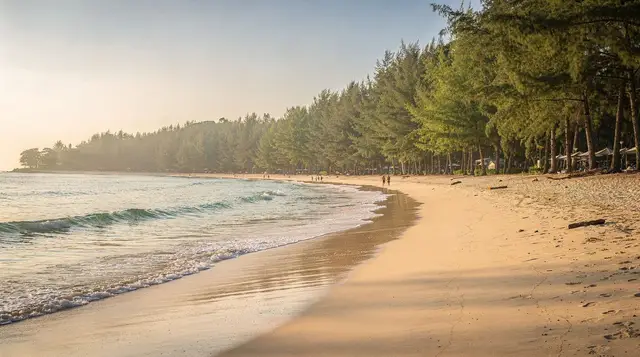
The smallest of the north coast’s three quiet beaches
Nai Thon sits between Nai Yang to the north and Layan Beach to the south, and it’s easy to overlook precisely because both of its neighbours have a clearer identity — Nai Yang has its national park status and beachfront restaurants, Layan has its upscale resorts and lagoon. Nai Thon has neither, and that’s more or less the point. It’s a small, curved bay backed by forested hills, with a short run of low-key restaurants and guesthouses set back from the sand rather than crowding it, and it stays the quietest of the three even during Phuket’s busiest months.
There’s no national park boundary drawing day-trippers here and no cluster of five-star resorts putting it on a luxury-travel itinerary. What draws people to Nai Thon is mostly word of mouth from travellers who found Nai Yang a little too organised and Layan a little too polished, and wanted something in between — a real, workable beach with a couple of places to eat, and not much else.
The beach itself
Nai Thon’s bay is compact, maybe 1 kilometre end to end, curving gently between two rocky headlands that give it more shelter than the long, exposed sweep of Mai Khao further north. The sand is fine and pale, the water clears up nicely in the dry season, and the shallow shelf makes for comfortable swimming when conditions are calm. Development is genuinely light here — a scattering of small hotels and villas in the hills behind the beach, a handful of restaurants along the access road, and long stretches of the sand itself with nothing built on it at all.
Shade comes from a thin band of trees at the back of the beach rather than a continuous treeline, so plan for more open sun exposure than at Nai Yang. Facilities are minimal: a few sun lounger rentals attached to the beachfront restaurants, no organised water sports rental row, and nothing resembling the beach-club setup you’d find at Bang Tao or Kamala.
Elephants, not just beach
The main organised activity near Nai Thon isn’t on the beach at all — it’s inland, at one of the ethical elephant care projects that this stretch of the island has become known for. a half-day elephant care experience based right in the Nai Thon area lets you feed, walk with, and observe rescued elephants without riding, which is the standard now for any operation that describes itself as ethical — see our ethical elephant sanctuaries guide for what separates a genuine rescue project from a rebranded riding camp.
If you’d rather compare options before booking, a guided eco-tour to a nearby elephant sanctuary covers similar ground with a slightly different itinerary and group format — both are reasonable ways to spend a morning before or after a swim at Nai Thon, since the sanctuaries here sit only a short drive inland from the beach.
Getting to Nai Thon
From Phuket Airport (HKT): About 20–25 minutes by road. A taxi or Grab runs roughly 400–550 B (about $11–16).
From Patong or the west-coast strip: 30–40 minutes, similar to the drive time for Layan and Bang Tao, since all three sit along the same stretch of coast road. Expect 500–700 B (about $14–20) by taxi or Grab.
From Nai Yang or Layan directly: Both are a short 10–15 minute drive, making it easy to combine two or all three of the north coast’s quiet beaches in a single day if you have your own transport.
| From | Time | Price (one-way) |
|---|---|---|
| HKT Airport | 20–25 min | 400–550 B (~$11–16) |
| Nai Yang | 10–15 min | 250–350 B (~$7–10) |
| Layan Beach | 10–15 min | 250–350 B (~$7–10) |
| Patong | 30–40 min | 500–700 B (~$14–20) |
As with the other north-coast beaches, there’s no reliable public songthaew route out here — a rented scooter (see our scooter rental guide) or a taxi/Grab is the practical option, especially if you’re planning to move between beaches during the day.
Sea conditions
Nai Thon follows the same seasonal pattern as the rest of Phuket’s west-facing coast: calm, clear conditions from roughly November to April, and rougher surf with stronger currents during the southwest monsoon from May to October. The bay’s headland shelter takes some of the edge off compared with fully exposed beaches, but that’s not a guarantee of safety on a rough day — red flags, where posted, should be treated as a hard stop, not a suggestion. There’s minimal lifeguard presence here compared with the bigger resort beaches, so read our beach safety and riptides guide and be conservative about swimming out during anything other than calm conditions.
Food and staying over
Nai Thon’s food options are limited to a handful of restaurants along the beach access road — mostly simple Thai and seafood places, with meals typically running 150–250 B (about $4–7) for a standard plate, rising for fresh seafood by weight. It’s enough for a relaxed lunch or dinner, but nowhere near the choice you’d get at Bang Tao, a short drive south.
Accommodation is a mix of small boutique hotels and villas set into the hillside, generally quieter and smaller-scale than the resort towers at Layan or the big brand hotels further along the coast. It suits travellers who want a genuinely low-key base near the north coast beaches without needing a five-star budget or a full evening’s worth of restaurant options on their doorstep.
Where to stay around Nai Thon
Nai Thon’s accommodation is genuinely small-scale compared with almost anywhere else on this list — a handful of boutique hotels and private villas set into the hillside behind the beach, with no large international resort chains directly on the sand. That’s part of the appeal for travellers who specifically want to avoid the scale of Layan’s resort complex or Bang Tao’s Laguna development, but it also means fewer amenities on-site: don’t expect a sprawling resort with five restaurants and a kids’ club, and book ahead in high season since the room count here is genuinely limited.
Villas in the hills above the beach often come with private pools and sea views, a reasonable option for a group or a longer stay if you want privacy over resort facilities. For a wider range of hotel categories and price points while staying close by, Nai Yang and Layan Beach both offer more choice within a short drive.
A sample day at Nai Thon
A typical day starts with the beach itself in the cooler morning hours — swimming if conditions are calm, or a walk along the compact bay and out toward the rocky headlands at either end, where tide pools and quieter coves reward a bit of scrambling. Late morning is a good window for the elephant sanctuary visit covered above, timed to avoid both the worst of the midday heat and the crowds that build at more heavily marketed sanctuary operations elsewhere on the island.
Lunch is simplest at one of the handful of restaurants along the beach access road — nothing elaborate, but reliably fresh and reasonably priced. Afternoons are for more of the same unhurried pace: reading in the shade, a slow swim, or a short scooter ride to compare Nai Yang or Layan if you want to see how the three beaches differ within a single afternoon. Evenings tend to wind down early here, in keeping with the whole area’s character — this is not a beach for late nights.
How Nai Thon compares to its neighbours
| Beach | Development | Restaurant choice | Best for |
|---|---|---|---|
| Nai Thon | Minimal | Limited | Genuine quiet, small-scale stays |
| Nai Yang | Light, national park | Moderate (beachfront seafood) | Airport proximity, beach dining |
| Layan Beach | Upscale, moderate | Limited on-beach, strong nearby | Calm water with amenities close by |
If you’re trying to choose between the three, Nai Thon is the right call when what you want most is the smallest possible footprint of other people and buildings, even if it means fewer dining options and less to do after dark. For a fuller comparison of the whole north coast against the busier west-coast beaches, see our north vs south Phuket guide.
Frequently asked questions about Nai Thon beach
Is Nai Thon quieter than Layan or Nai Yang?
Yes, generally — it has fewer restaurants than Nai Yang and far less resort development than Layan, and stays the least crowded of the three even during Phuket’s busiest months.
Can I swim at Nai Thon?
Yes, in the dry season (roughly November to April) conditions are calm and the shallow shelf makes for comfortable swimming. During the southwest monsoon, expect stronger surf and currents, with minimal lifeguard presence to rely on.
Is there an elephant sanctuary near Nai Thon?
Yes, one of Phuket’s ethical elephant care projects operates in the Nai Thon area, offering feeding and observation experiences without riding — a short drive inland from the beach itself.
How do I get between Nai Thon, Nai Yang, and Layan Beach?
All three are 10–15 minutes apart by road, making them easy to combine in a single day if you have a scooter or a taxi arranged for the day rather than one-off trips.
Are there hotels directly on Nai Thon beach?
A small number of boutique hotels and villas sit in the hills close to the beach rather than directly on the sand, keeping the shoreline itself relatively undeveloped compared with Layan.
Is Nai Thon a good base for a full trip, or just a day visit?
It works as either. The limited restaurant choice makes it a quieter base than Bang Tao or Kamala, so it suits travellers who specifically want fewer options and more quiet, or a half-day stop for anyone based elsewhere on the north coast.
Is Nai Thon good for snorkelling?
There’s some snorkelling around the rocky headlands at either end of the bay in calm conditions, with reasonable visibility outside monsoon season, though it’s a casual add-on rather than a dedicated dive or snorkel destination. Bring your own gear, since rental options directly on the beach are limited.
Does Nai Thon have any shops beyond the beach restaurants?
Very little — a small minimart or two along the access road, but nothing resembling a proper shopping strip. For groceries, pharmacies, or a wider choice of shops, Nai Yang or Bang Tao are the nearest practical options.
Is Nai Thon worth visiting if I only have one day in the north of the island?
It depends on what you value most. If quiet sand and a genuine break from other tourists matter more than variety, Nai Thon is a strong choice. If you would rather have restaurant options and some activity on hand, Nai Yang or Layan Beach make better use of a single day for most travellers, since Nai Thon’s own list of things to do outside the beach and the nearby elephant sanctuary stays genuinely short.
How busy does Nai Thon get in high season?
Even at the busiest point of the dry season, Nai Thon stays noticeably quieter than any of the west-coast resort beaches, since the limited accommodation and lack of day-trip infrastructure naturally cap how many people can be on the sand at once at any given time. It never reaches anything close to the density of Patong or Kata Beach, even on the busiest weekends of the year.
Does Nai Thon have lifeguards year-round?
Coverage, where it exists, is seasonal and lighter than at the major resort beaches. Do not assume a lifeguard is watching the water at any given time, particularly outside the main dry-season months, and treat the flag system and your own judgement as the primary safeguard rather than relying on a rescue response.
Practical notes and what to bring
Bring cash, since the small restaurants and any lounger rentals here rarely take cards, and there is no dense ATM network directly on the beach. Sun protection matters more at Nai Thon than at the more heavily shaded beaches further north, given the thinner treeline, and insect repellent is worth having if you’re staying in one of the hillside villas backing onto forest. If you’re combining a beach morning with the elephant sanctuary visit, wear clothing you don’t mind getting a little wet and muddy, and closed shoes rather than sandals for the walking involved in most feeding and care experiences.
Mobile signal and Wi-Fi are generally reliable at the hotels and restaurants here, but don’t expect much beyond that — this is not a beach with public Wi-Fi hotspots or co-working cafés the way busier parts of the island have developed. Treat a visit to Nai Thon as a genuine break from that kind of connectivity as much as from crowds.
For a day trip rather than an overnight stay, plan to arrive by mid-morning and leave time to explore both the beach and the elephant sanctuary properly — trying to fit both into a rushed half-day from a base further south usually means shortchanging one or the other. If you only have time for one, base the decision on what you came to this side of the island for: the beach itself, or the wildlife experience, since combining them well genuinely benefits from a full day rather than a squeezed half-day detour.
Travellers coming from Patong or Kata specifically for a Nai Thon day trip should also factor the return drive into their evening plans, since the road back over the hills is not one most people want to do after dark on a scooter, and a taxi back at a reasonable hour is worth arranging before the light fades rather than after.