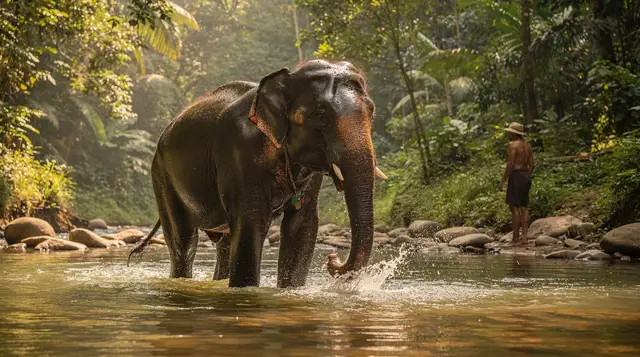
Ethical elephant sanctuaries in Phuket
How do I find a genuinely ethical elephant sanctuary near Phuket?
Look for a place that never offers riding, never runs a show or trick performance, keeps guest-elephant contact to guided feeding or bathing at most, and is upfront about using guides and barriers rather than claiming completely hands-off, chain-free conditions it can't actually guarantee.
“Sanctuary” is not a protected word
Anyone can put “sanctuary” or “ethical” on a sign in Thailand — there’s no licensing body that checks the claim before a business opens, and after the well-documented backlash against elephant riding and circus-style shows over the past decade, a large share of former riding camps simply repainted themselves.
Same elephants in some cases, same enclosures, same underlying relationship between animal and handler, but the brochure now says “sanctuary,” “rescue” or “ethical experience,” and riding has often been swapped for bathing and feeding instead. That’s sometimes a genuine improvement and sometimes closer to marketing than change. This page exists to give you a way to tell the difference, because the phrase “ethical elephant sanctuary” alone tells you almost nothing.
What genuinely disqualifies a place, no exceptions
- Riding, in any form — bareback or with a saddle/howdah. This is the clearest, simplest red line. A place still offering riding is not a sanctuary regardless of what else it does or calls itself.
- Shows or tricks — painting, playing football, balancing, “dancing.” These require the kind of early, often harsh training historically used to break an elephant’s will, and a place still running them hasn’t actually moved away from that.
- Chains and hooks used on guests’ watch, or visible scarring consistent with a bullhook (ankus) around the head and ears. A short chain used briefly and openly to manage feeding time is a different, more defensible thing than permanent chaining or a keeper carrying a hook where the animal can see it.
- Unlimited, unsupervised guest contact. A genuine operation controls interaction — a guide present at all times, clear rules about where guests can and can’t touch, and limited group sizes near each elephant. A free-for-all with a queue of tourists petting and photographing without oversight is a welfare risk for the animal regardless of intent.
What a genuinely better place still involves — and the honest debate around it
Here’s the part that a lot of “ethical sanctuary” marketing glosses over: even the better operations — the ones that don’t ride, don’t run shows, and control contact carefully — still involve captive elephants that were, in nearly every case, born or brought into the tourism or logging industry, not rescued from the wild into a truly wild-equivalent setting. Feeding and supervised bathing are widely considered a real improvement over riding and performance, and organisations like World Animal Protection and the Asian Captive Elephant Working Group have used exactly this kind of assessment to rank operations.
But some welfare advocates go further and argue that any close-contact tourism — feeding by hand, bathing alongside guests — still requires enough control over a multi-tonne wild animal that some form of behind-the-scenes management (short chaining at night, controlled feeding schedules, guide proximity with a hook kept out of sight) is standard practice even at well-regarded places. That’s not necessarily disqualifying, but it means the honest bar to look for is “meaningfully better and transparent about its methods,” not “completely hands-off and chain-free,” a claim that’s rarely fully true and worth treating with scepticism when a brochure states it flatly.
The most defensible category, if you want the clearest conscience, is observation-only: watching elephants in a large enclosure or forest area from a walkway or platform, with feeding done by keepers rather than guests, and no bathing or touching component at all. It’s a less “hands-on” day, and it’s the version closest to an actual sanctuary in the strict sense of the word.
Riding camp vs. feeding/bathing sanctuary vs. observation-only
| Old-style riding camp | Feeding/bathing “sanctuary” | Observation-only | |
|---|---|---|---|
| Riding offered | Yes | No | No |
| Shows/tricks | Often | No | No |
| Guest contact | Riding, sometimes touching | Hand-feeding, sometimes bathing alongside | Minimal to none |
| Chains/hooks visible to guests | Common | Sometimes, briefly, during feeding | Rare — animals typically at a distance |
| Welfare assessment | Poor | Improved but debated | Closest to genuine sanctuary conditions |
Where to actually find one near Phuket
Several operations sit within reasonable driving distance of the island’s main resort areas, generally inland toward Kathu, around the Wat Chalong area near Chalong, and up near Naithon in the island’s north. A guided tour with hotel transfer is the standard way to visit, since public transport doesn’t reach most of these sites directly — see getting around Phuket if you’re weighing a rental scooter against a transfer for this specifically.
Patong ethical elephant sanctuary tour with transferAn eco-guided format that leans toward observation and controlled feeding rather than bathing is a reasonable middle ground if you want some proximity without the full hands-on bathing experience.
Eco guided tour at elephant sanctuaryFeeding-focused half-day formats are the most common option close to Phuket’s main resort areas, generally running a few hours rather than a full day.
Elephant Jungle sanctuary ethical feeding experienceFor a larger-scale operation with more space per animal, it’s worth looking further afield to Khao Lak, roughly 90 minutes to two hours north of Phuket’s resort areas — a longer day than the closer options, but some of the larger, more established sanctuaries in the region sit in that direction rather than on Phuket itself.
Khao Lak elephant sanctuary full-day tourWhat a visit actually costs
Half-day visits close to Phuket’s resort areas typically run 1,800–3,000 baht (about $50–$85) per adult, usually including hotel transfer, a set of clothes to change into (bathing and feeding gets you genuinely wet and muddy), and a meal. Full-day visits to larger sanctuaries further away, like those near Khao Lak, run higher, often 3,000–4,500 baht (about $85–$130), reflecting the longer transfer and more extensive programme. Prices below this range are worth extra scrutiny — a very cheap “sanctuary” visit is more likely to be cutting corners on animal welfare, group size, or both, since feeding and caring for adult elephants is genuinely expensive to do properly.
Questions worth asking before you book
- “Do you offer riding, at any point in the visit?” The answer must be an unambiguous no.
- “How many elephants are there per keeper, and how many guests are in a group at once?” Smaller numbers on both counts generally mean more attentive, less rushed handling.
- “Where did the elephants come from?” A place with a real answer — often former logging or riding-camp elephants — is more credible than one that’s vague or claims all animals were “rescued from the wild,” which is rare and, for adult elephants already habituated to humans, usually not accurate or even possible to reverse.
- “Is bathing optional?” A place that lets you choose observation-only over getting in the water with the animals is giving guests more control, which is itself a good sign about how the operation treats choice and consent generally.
Reading reviews the right way
Star ratings alone tell you very little here — a place can average 4.5 stars from guests who had a lovely day and never thought to look for the signs above. Search reviews specifically for the words “chain,” “hook,” “scar” or “thin” rather than skimming for overall sentiment; a handful of reviewers mentioning visible scarring or a keeper carrying a hook is worth more than a hundred generic five-star reviews praising the setting. Photos attached to reviews are useful for the same reason — they show what the operator’s own marketing photos won’t. Recent reviews matter more than old ones, since management, ownership and practices at these operations can change; a glowing review from several years ago says little about current conditions.
How this connects to Phuket’s wider wildlife tourism
Elephants aren’t the only animal where “ethical” claims deserve scrutiny in Phuket. The same scepticism is worth applying to macaques at Monkey Hill and the Big Buddha (see monkeys in Phuket safety for what’s actually risky about those encounters), and to the elephant acts that still appear in some evening shows — FantaSea, for one, features elephants on stage, which is a meaningfully different proposition from a genuine sanctuary regardless of how the show markets itself.
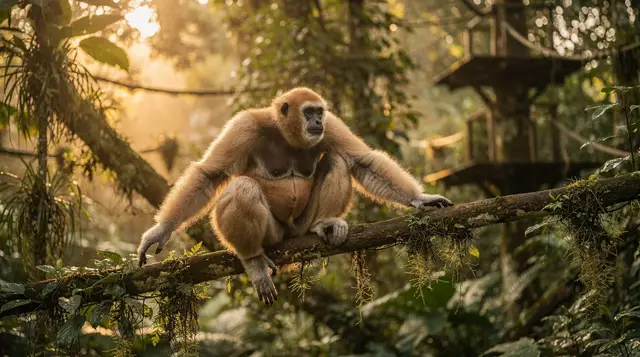
On the more reassuring end, the gibbon rehabilitation project near Bang Pae Waterfall inside Khao Phra Thaeo National Park is a clearer example of the observation-only model done well — no touching, no riding, no feeding by guests, just supervised viewing of animals on an actual path toward release. If you want a wildlife encounter with less ethical ambiguity than any elephant visit currently carries, that gibbon project and the surrounding national park make a reasonable pairing for the same day.
What never to do, even if it’s offered
Never ride, even bareback, even if a keeper insists it’s “different” from the old howdah-style riding — it isn’t, mechanically, for the animal’s spine and behaviour training. Never pay extra for a photo op that involves an elephant performing a trick, balancing, or posing in a way that looks staged rather than natural. Never buy into a program that separates a baby elephant from its mother for photos — legitimate operations keep family groups together. And never assume “no visible chains” during your visit means no chains are used at night or off-camera; ask directly rather than taking the absence of what you personally see as proof of anything.
What a good day actually looks like, hour by hour
A well-run half-day visit typically starts with a short briefing on the elephants present — names, ages, background, and often a specific rescue story rather than a vague generality — followed by preparing food (usually cut fruit and vegetables) that guests hand-feed under a keeper’s direction. A supervised walk alongside the elephants through the property, kept at a pace the animals set rather than a guest itinerary, often follows, sometimes ending at a mud pit or shallow pool for bathing if the operator offers it and you’ve opted in.
Guides who narrate behaviour — why an elephant flaps its ears, why it stays close to a particular herd-mate — tend to reflect operations that genuinely understand and prioritise animal welfare over a scripted photo-op sequence. If your entire visit feels rushed toward a series of staged photo moments with little explanation in between, that’s a reasonable sign the operator’s priorities sit elsewhere.
The bigger picture: why boycotting entirely doesn’t simply fix this
It’s tempting to conclude that the most ethical choice is to skip elephant tourism altogether, and for some travellers that’s the right call. But it’s worth understanding the economics before deciding: Thailand banned commercial logging in 1989, which put thousands of working elephants and their mahout families out of their traditional livelihood almost overnight, and tourism — riding camps first, then the better sanctuary model — became the main way those elephants and the people who depend on them stayed fed.
An elephant eats roughly 150–200kg of food a day and can’t simply be released into a shrinking, already-crowded wild habitat after a lifetime in captivity; genuine reintroduction to the wild is exceptionally rare and generally not viable for animals raised around humans. That doesn’t excuse poor welfare at any given operation, but it does mean that supporting the better-run, transparent sanctuaries with your money — rather than opting out of the sector entirely — is a more direct way to shift the industry’s incentives toward the observation and feeding model and away from riding and performance, which is exactly the shift that’s already been happening over the past decade as demand moved.
Frequently asked questions about elephant sanctuaries in Phuket
Is bathing with elephants ethical?
It’s genuinely debated among welfare organisations. Most consider guided, supervised bathing a real improvement over riding and shows, but some argue it still requires a level of control over the animal that isn’t fully hands-off. Observation-only visits are the more conservative choice if this matters strongly to you.
How can I tell if a sanctuary still uses bullhooks?
Look closely at the elephant’s head and ears for scarring, and watch whether keepers carry a hook (ankus) visibly during your visit. A place with nothing visible isn’t automatically hook-free off-camera, but visible hooks or fresh-looking scarring are a clear warning sign.
Are there truly wild, non-captive elephant experiences near Phuket?
Not really, in the sense of guaranteed sightings — wild elephant populations exist in protected areas of southern Thailand but aren’t a reliable tourism product the way captive sanctuary visits are. What’s available near Phuket is captive-elephant tourism of varying quality, not wild encounters.
Why do some sanctuaries still chain elephants at night?
Adult elephants, even well-cared-for ones, can be dangerous if unrestrained near staff quarters or neighbouring land at night, and secure large-enclosure fencing is expensive to build and maintain. Short-term nighttime tethering at an otherwise good operation is a different, more defensible practice than the all-day chaining seen at poor ones — but it’s still worth asking about directly.
Is it better to skip elephant tourism entirely?
That’s a legitimate personal choice, but it’s not automatically the most helpful one for the animals already in captivity, who depend on funding from somewhere. Choosing a transparent, no-riding, no-show operation is a more direct way to support the better end of the industry than opting out completely.
How much does an ethical elephant sanctuary visit cost near Phuket?
Half-day visits close to the main resort areas typically run 1,800–3,000 baht (about $50–$85) per adult including transfer. Full-day visits to larger sanctuaries further away, such as near Khao Lak, run higher, often 3,000–4,500 baht (about $85–$130).
Can children visit elephant sanctuaries in Phuket?
Yes, most operations welcome children, and feeding activities in particular are popular with families. Bathing components involve mud and water, so bring a change of clothes, and supervise young children closely around any large animal regardless of how calm it appears.
tours.nature-wildlife
Verified deep-linked GetYourGuide tours. Book through these links and we earn a small commission at no cost to you.
These are our own photographs of Phuket, not the operator's pictures of this tour — open the tour page to see those.