Gibbon rehabilitation project — Phuket's hands-off wildlife centre
Can you interact with the gibbons at the Phuket Gibbon Rehabilitation Project?
No. The entire point of the project is that visitors don't touch, hold or pose with the gibbons — you view rescued animals from a walkway while they're prepared for release back into the forest.
A rescue centre with one rule that overrides everything else
Most Phuket wildlife stops are built around contact: feed this, ride that, hold this for a photo. The Gibbon Rehabilitation Project, tucked into Khao Phra Thaeo beside Bang Pae Waterfall, is built around the opposite idea. It exists to take gibbons out of captivity — cages behind guesthouses, tourist photo props, illegal pets confiscated by wildlife officers — and prepare them to live wild again. Contact with humans is exactly what the project is trying to undo, so the visit is structured so you never get one. You walk a raised boardwalk, look into forest enclosures, read information boards, and leave a donation. That’s the whole interaction, and it’s deliberate.
It isn’t a big attraction and it doesn’t try to be. There’s no gift shop selling gibbon plush toys pretending to fund conservation, no staff member offering a “special” close-up for a tip, no photo booth. If you’ve read about animal welfare problems elsewhere on the island — and Phuket has plenty, particularly around elephants — this is close to the opposite model: modest, unglamorous, and genuinely working toward getting animals off the payroll of tourism altogether.
What the project actually does
White-handed (lar) gibbons were once common across Phuket’s forests. Decades of habitat loss, illegal capture for the pet trade, and roadside photo-op businesses pushed the wild population toward local extinction on the island.
The project, founded in the late 1980s and run since with a mix of donations and volunteer labour, takes in gibbons confiscated from captivity or surrendered by owners, and works them through a multi-stage process: medical assessment and quarantine, pairing with a compatible mate (gibbons are monogamous and need a partner before release), a period in a large forest enclosure to rebuild climbing strength and natural behaviour, and — for animals that make it through every stage — release into protected forest, sometimes on Phuket, sometimes at partner sites elsewhere in Thailand.
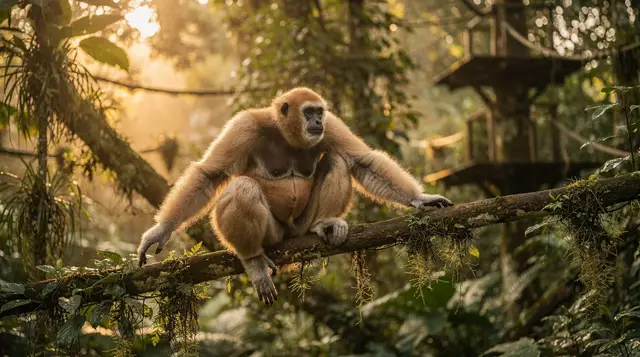
Not every gibbon that arrives is releasable. Some were pets for so long, or are missing digits from being chained, that they’ll live out their lives at the centre instead. Enclosures you pass on the boardwalk hold gibbons at different stages of that spectrum — some visibly wary of people, some more settled, none of them performing for visitors, because performing isn’t the goal.
Visiting: hours, cost, what you’ll see
There’s no ticket booth with a fixed price. The project runs on a donation basis, typically suggested at somewhere around 100–200 THB (roughly $3–6) per adult, dropped in a box near the entrance — bring small notes, since there’s rarely anyone to make change. It’s open during daylight hours, broadly matching Khao Phra Thaeo’s own gate times, and a visit itself takes 20–40 minutes: you’re reading boards and looking into a handful of enclosures set among trees, not touring a zoo-sized complex.
Expect to see gibbons at a distance, often high in the enclosure canopy or resting quietly rather than swinging on cue — they’re wild animals recovering from captivity, not performers, and a quiet or empty-looking enclosure on a hot afternoon is normal, not a failure of the visit. Bring binoculars if you have them; a phone camera zoom mostly gets you a green blur.
Jungle trekking at Khao Phra ThaeoGetting there and pairing it with Bang Pae
The centre sits at the edge of Khao Phra Thaeo National Park in Thalang, on Phuket’s inland north side, a short walk from the Bang Pae Waterfall car park. Most visitors combine the two on foot in a single stop: park at Bang Pae, walk the short, flat path to the gibbon centre first (it’s the quieter, shadier part of the visit), then continue to the falls themselves — covered in full in the Phuket waterfalls guide, including why the falls themselves are underwhelming in the exact months most tourists visit.
There’s no public transport that gets you close; a rented scooter (see scooter rental in Phuket) or a car via Grab or a taxi are the realistic options, and neither trip takes more than 30–45 minutes from most west-coast beach areas. If you don’t want to self-drive, this stop rarely appears alone on a tour itinerary — it’s usually bundled into wider Khao Phra Thaeo or jungle-trekking bookings that pass the area, or added as a side stop by drivers doing a custom day. For general logistics around the island, getting around Phuket covers all the options side by side.
Why “sanctuary” gets used loosely on this island — and how this one is different
Phuket markets a lot of animal encounters as ethical without much behind the label. Elephant “sanctuaries” that still let you scrub, feed and selfie with elephants at close range on a fixed schedule aren’t meaningfully different in stress terms from the riding camps they replaced — the ethical elephant sanctuaries guide goes into how to tell the difference. Gibbon “cafes” and photo spots in some tourist strips still exist too, usually with a single chained or drugged animal kept for tips.
The Gibbon Rehabilitation Project is a genuine outlier because its funding model doesn’t depend on maximising contact time. A donation box and an information board don’t monetise better the longer you linger near an enclosure, so there’s no incentive to stage anything. If you want a rule of thumb for the rest of the island: any operator offering to let you hold, feed by hand, or photograph up close with a wild animal for an extra fee is running a different kind of business than this one, whatever the sign out front says. See Phuket scams to avoid for the wider pattern.
The species behind the project
White-handed gibbons, also called lar gibbons, are smaller and lighter-boned than the macaques most visitors encounter elsewhere on the island — built for swinging hand-over-hand through canopy rather than walking on the ground, with an extraordinary reach relative to their body size. They’re monogamous, pairing for life and defending a territory together with loud, distinctive morning calls that carry for long distances through forest; hearing one echo across Khao Phra Thaeo, even without seeing the animal, is arguably the more memorable part of a visit than the enclosure viewing itself.
This social structure is part of why rehabilitation takes years rather than months: a rescued gibbon typically needs to be paired with a compatible, unrelated mate before release is even considered, and pairing two traumatised animals successfully isn’t guaranteed on the first attempt.
Wild gibbon populations on Phuket itself were effectively wiped out by habitat loss and capture for the pet and photo-prop trade well before the project began, which is why most successful releases now happen at protected forest sites elsewhere in Thailand rather than directly back into Khao Phra Thaeo — the remaining forest here, while protected, is smaller than what a stable wild population would need long-term. The project’s own website and on-site information boards give more detail on current release sites and success rates than a single visit’s signage can cover; read them if the topic interests you, since the picture changes as the program’s outcomes are updated.
How this compares to other Khao Phra Thaeo stops
Because the gibbon centre sits inside a working national park rather than a stand-alone attraction, it’s easy to build into a longer inland morning. Bang Pae Waterfall, a short walk from the centre, is covered fully in the waterfalls guide, including why the flow is weakest in exactly the months most beach-focused visitors are on the island.
Jungle trekking routes through the same park go further into the forest than the gibbon boardwalk or waterfall paths, for visitors who want more than an hour of walking. None of these stops require a fixed booking or a set start time the way a boat tour does, which makes Khao Phra Thaeo one of the more flexible half-days on the island if you’re self-driving rather than relying on a scheduled tour.
What to bring and how to behave
- Cash in small baht notes for the donation box
- Insect repellent — the boardwalk runs through shaded forest edge, prime mosquito territory
- A hat and water; there’s little shade at the car park itself
- Closed shoes rather than sandals if you’re continuing on to the waterfall trail afterward
- Patience: enclosures are spaced along a path, and some visits genuinely mean 10 minutes of quiet forest and one distant gibbon call
Keep voices down near the enclosures — these are recovering animals, not a backdrop, and noise stresses them the same way handling would. Don’t tap on glass or mesh, don’t offer food of any kind (their diet is medically managed), and don’t expect staff to pose an animal for you; if someone at any Phuket wildlife venue offers to do that for a tip, it’s a sign to leave, not a bonus.
Guided rainforest hike with lunchFunding, volunteering and donating beyond a visit
The project runs almost entirely on donations and volunteer labour rather than government funding, which is part of why the on-site experience feels understated compared to better-marketed attractions elsewhere on the island. Beyond the entrance donation, longer-term volunteering placements exist for people who can commit weeks rather than a single afternoon, typically involving enclosure maintenance, food preparation and general animal-care support under staff supervision — not hands-on contact with the gibbons themselves, since the no-contact rule applies to volunteers as much as to day visitors.
If a single visit leaves an impression and you want to do more, the project’s own channels (checked directly, not through a third-party booking site) are the reliable way to find current volunteering or additional-donation options, since these details change more often than a static guide can track.
Best time to visit
Early morning, before roughly 10am, gives you the coolest temperatures and the best odds of gibbons being active near the front of enclosures rather than retreated into shade. The dry season (November through April) is the more comfortable time to walk the boardwalk and combine the stop with Bang Pae or Ton Sai; during the May–October monsoon the paths get muddy and leeches turn up on the forest floor after rain, which is more of a nuisance here than a real hazard, but worth knowing before you wear sandals.
Who should skip it
Anyone expecting close-up animal photos, a guaranteed sighting, or an interactive experience will be disappointed — that disappointment is the honest signal the project is doing its job rather than staging one. Families with very young children who need constant stimulation may find the 20–30 minute quiet walk a hard sell compared to a water park or a beach with easy swimming.
If wildlife-watching interests you but you want a livelier stop, ethical elephant sanctuaries offer more visible activity, though at a real cost in animal stress that this project specifically avoids. For travellers building a 5-day Phuket itinerary or a longer day-trip list, this works best as a 30–45 minute add-on to a Khao Phra Thaeo morning, not a stand-alone half-day.
Combining the visit with a longer inland day
Because the centre and Bang Pae sit at Khao Phra Thaeo’s edge rather than deep inside it, they work as the calm anchor of a busier inland day rather than the whole plan. Some visitors pair the morning here with an afternoon stop at Wat Chalong or the Big Buddha further south, splitting a self-driven day between quiet forest and Phuket’s more visited cultural sites — worth planning as two distinct halves rather than rushing between them, since the contrast is part of what makes the day interesting.
Families building a Phuket itinerary with kids sometimes use this stop as a lower-key morning between beach days, when younger travellers need a break from sun and swimming without losing the day entirely.
Frequently asked questions about the Phuket Gibbon Rehabilitation Project
Is the Gibbon Rehabilitation Project free?
There’s no fixed entrance fee, but a donation of around 100–200 THB (about $3–6) per adult is expected and funds the rescue and release work directly — treat it as the actual cost of the visit, not an optional extra.
Can I hold or feed a gibbon here?
No, and any operator elsewhere in Phuket offering that experience with a gibbon is not running an ethical facility — captive-bred handling and photo ops with gibbons are part of the same illegal pet trade this project exists to counter.
How long does a visit take?
Realistically 20–40 minutes for the boardwalk and information boards, longer if you linger to spot animals or read every panel. Most visitors combine it with the short walk to Bang Pae Waterfall for a half-morning stop.
Will I definitely see a gibbon?
No. Gibbons spend time deep in the enclosure canopy or resting out of view, especially in the heat of midday. Early morning visits improve the odds, but sightings aren’t guaranteed at any wildlife centre where animals aren’t confined for display.
Is it suitable for young children?
It’s calm rather than exciting — fine for curious kids who can walk a short shaded path quietly, less suited to toddlers who need constant activity. Pair it with a livelier stop the same day if travelling with a mixed-age group.
How do I get there without a rental scooter?
Grab and metered taxis both reach the Bang Pae car park; agree the fare or confirm the meter before departing, since it’s outside the main tourist strips where drivers sometimes quote flat rates. There’s no useful public bus route.
Does the project release gibbons back into the wild?
Yes, when an animal’s health and behaviour allow it — after quarantine, pairing with a mate, and a period of enclosure rehabilitation. Not every gibbon that arrives is a candidate for release; some, particularly former long-term pets with physical injuries, stay at the centre permanently.
tours.nature-wildlife
Verified deep-linked GetYourGuide tours. Book through these links and we earn a small commission at no cost to you.
These are our own photographs of Phuket, not the operator's pictures of this tour — open the tour page to see those.