Big Buddha Phuket guide
Is the Big Buddha in Phuket worth visiting?
Yes for the views and the scale of the statue, but go in knowing it's still an active construction site around the base after years of ongoing work, and the access road is a narrow, winding climb that's uncomfortable in a rented scooter for inexperienced riders.
What you’re actually visiting
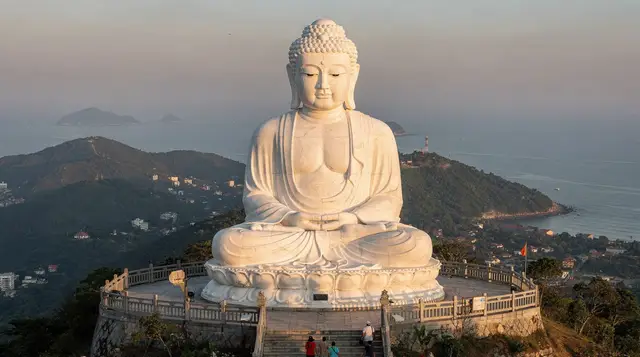
The Big Buddha sits atop Nakkerd Hill in south Phuket, a 45-metre seated figure clad in white Burmese marble, visible from much of the island’s west coast on a clear day. It’s one of the most-photographed landmarks in Phuket, and the appeal is straightforward: the statue’s scale up close, and the 360-degree views over Chalong, Kata and the Andaman coastline from the hilltop platform. It’s also, as of any recent visit, still an active construction site in places — worth knowing before you go so the scaffolding and unfinished sections around the base don’t come as a surprise.
The access road, honestly
Getting to the Big Buddha means driving a narrow, winding road up Nakkerd Hill with a genuine gradient and tight switchback curves — not a difficult drive in a car, but a road that catches out inexperienced scooter riders, especially in wet weather when the surface gets slick. If you’re renting a scooter and haven’t ridden much on hills or in traffic before, this is one of the routes where a taxi, Grab, or joining a tour makes more sense than self-driving. Parking near the top is limited and can fill up around midday and at sunset, the two busiest windows.
Phuket half-day viewpoint, Big Buddha and Wat Chalong tourEntry, donations and what it costs
There’s no fixed admission fee — entry is by voluntary donation, with donation boxes near the entrance. There’s no wrong amount, but most visitors leave somewhere in the range of 20–100 THB (roughly $0.60–$3) per person; it’s genuinely optional, not a disguised ticket price. Parking, if you’re driving yourself, may carry a small separate charge depending on the lot.
Dress code — this one gets enforced
Because it’s an active religious site, not just a viewpoint, the dress code is enforced more consistently here than at some of Phuket’s more casual temples: shoulders and knees covered for both men and women. Sarongs are available to borrow or rent near the entrance for anyone who arrives in shorts or a tank top, but it’s simpler to dress appropriately from the start rather than counting on a rental being available. Shoes come off before stepping onto the main platform around the statue itself.
The ongoing construction, and why it matters
This needs saying plainly because a lot of listings gloss over it: the Big Buddha complex has been under partial construction for years, with sections of the base, surrounding halls and pathways in various states of unfinished work depending on when you visit. It doesn’t stop you from seeing the statue or the views, but don’t expect a fully polished, finished monument — scaffolding, construction materials and roped-off areas are a realistic possibility on any given visit. Framing your photos to work around this, rather than being caught off guard by it, makes for a better visit.
Combining it with Wat Chalong
Because Big Buddha and Wat Chalong sit relatively close together in south Phuket, most guided tours and a lot of independent itineraries pair the two in a single half-day trip. Wat Chalong is the island’s most-visited working temple — different in character from Big Buddha’s viewpoint-monument feel, with active monks, incense, and the firecracker tradition locals use to give thanks. Doing both back to back gives a fuller picture of Phuket’s religious sites than either alone.
Phuket Big Buddha, Wat Chalong and town guided tourExtending into a full city tour
Several operators bundle Big Buddha and Wat Chalong with a stop in Phuket Old Town for its sino-Portuguese architecture and Thalang Road streetscape, turning the visit into a half- or full-day city overview rather than a single stop. This works well if you want a broad first-day orientation to the island’s culture and history side, rather than treating Big Buddha as an isolated photo stop.
Phuket city tour with Wat Chalong, Big Buddha and Old TownMonkeys near the site
Long-tailed macaques are present in the hills around Nakkerd, and while sightings near Big Buddha itself are less frequent than at dedicated spots like Monkey Hill, it’s still worth the standard caution: don’t feed them, keep food and dangling bags out of easy reach, and don’t try to touch or photograph one up close. Bites happen to visitors who misjudge how fast and unpredictable these animals are, and any bite from a macaque in Thailand should be treated seriously given the rabies risk.
Best time to visit
Early morning (before 9am) or late afternoon toward sunset are the two better windows — cooler temperatures for the walk up to the platform, softer light for photos, and in the case of sunset, one of the better elevated viewpoints on the island for it. Midday brings harsher light, more heat on the exposed platform, and the busiest crowds, since it’s when most day-tour buses schedule their stop.
Pairing with a distillery or rum tasting
For a different kind of half-day combination, a few operators pair Big Buddha with a visit to a local Chalong Bay rum distillery — a genuinely distinctive Phuket-made spirit, with tastings and a tour of the production process. It’s an unusual but well-matched pairing since both sit in the same part of south Phuket.
Phuket Chalong Bay rum and Big Buddha half-day private tourWhat a visit actually costs
Beyond the voluntary donation, budget for transport: a return taxi or Grab from the west-coast resort areas typically runs 500–800 THB (about $14–$22) depending on distance, while a half-day guided tour combining Big Buddha with Wat Chalong and Old Town usually costs 900–1,800 THB (about $25–$50) per person including hotel transfer. Self-driving avoids the transport cost entirely but comes with the access-road caveat already covered above.
Getting there without a tour
If you’re driving yourself, Big Buddha is roughly 20–30 minutes inland from Chalong and the southern west-coast beaches, and closer to 40–45 minutes from Patong. Signage improves closer to the base of the hill, but the turn-off from the main road is easy to miss on a first visit — following GPS navigation rather than road signs alone is the more reliable approach. Parking near the summit fills up around midday and sunset; arriving outside those windows makes finding a space considerably easier.
Big Buddha compared with Phuket’s other cultural sites
Big Buddha is more of a viewpoint-and-monument experience than an active place of worship in the way Wat Chalong is, and it’s worth setting expectations accordingly — you’re there for the statue’s scale and the views more than for a deep cultural or religious encounter. For travellers who want a fuller sense of Phuket’s living culture rather than a single monument, pairing it with Phuket Old Town and its sino-Portuguese shophouses, or timing a visit around the island’s Vegetarian Festival if your dates align, rounds out the picture considerably.
Photography tips
The clearest views and best light come in the early morning or shortly before sunset, when haze is lower and the crowds are thinner. Because sections of the site are under ongoing construction, framing shots to exclude scaffolding takes a bit of positioning — shooting from the lower viewing terraces or focusing tightly on the statue itself usually avoids the most visible construction areas. A wide-angle lens or your phone’s panoramic mode captures the 360-degree coastal view better than a standard shot.
Temple etiquette beyond the dress code
Beyond covering shoulders and knees, general temple etiquette in Thailand applies here: don’t point your feet toward any Buddha image while seated, don’t climb on statues or platforms for photos, and keep voices down near anyone in quiet reflection. These norms are less rigidly enforced at Big Buddha than at a fully active temple like Wat Chalong, but they’re still the respectful default, particularly since Big Buddha remains a working religious site rather than purely a tourist viewpoint.
What to bring
- Clothing that covers shoulders and knees, or be ready to rent a sarong at the entrance
- Comfortable shoes you can slip off easily at the platform
- Sun protection — the summit platform has very little shade
- Small baht notes for the donation box and any parking fee
- Water; there are vendors near the entrance, but prices climb the closer you get to the top
The view itself, in detail
The main platform gives a genuinely wide sweep of south Phuket: Chalong Bay and its cluster of moored yachts to one side, the ridgeline running toward Kata and Karon on the other, and on the clearest days, the outline of islands offshore. It’s one of the few spots on the island where you get a real sense of Phuket’s overall shape and scale in a single view, rather than the more enclosed perspective from beach level. Midday haze softens the distant detail considerably; the sharpest views tend to come in the hour or two after sunrise, before the day’s humidity builds up into visible haze over the coastline.
A note on the statue’s history
Construction of the Big Buddha began in the early 2000s, funded largely through public donations rather than government or single-donor money — part of why the site has progressed in phases over such a long period rather than opening all at once. That funding model is also why donation boxes remain a genuine part of the experience rather than a tourist add-on: the ongoing work around the base is, in a real sense, still being paid for one donation at a time. It’s a detail that reframes the construction you’ll see on site — less an unfinished attraction, more a long-running community project still underway.
Facilities on site
Expect basic amenities rather than a polished visitor centre: a handful of souvenir stalls near the entrance and parking area, simple toilet facilities, and drink vendors along the approach path. There’s no proper restaurant on site, so plan to eat before or after your visit rather than counting on food at the summit. Shade is limited once you’re on the open viewing platform, which is worth factoring into how long you plan to linger, particularly around midday.
Visiting as part of a multi-stop day
Because Big Buddha sits close to several other south Phuket attractions, it’s rarely the only stop on a day that includes it — most itineraries treat it as a 45-minute to one-hour anchor point within a longer half-day loop through Wat Chalong, Old Town, or occasionally a rum distillery. If you’re building your own route rather than joining a packaged tour, allow roughly 20–30 minutes of driving between each of these south Phuket stops, and don’t try to cram more than two or three into a single half-day given the access-road driving time each one adds.
Accessibility
The main viewing platform is reachable via a paved path and some stairs from the parking area, which makes it manageable for most visitors but genuinely difficult for wheelchair users or anyone with significant mobility limitations — there’s no dedicated accessible route around the ongoing construction work. If mobility is a concern, it’s worth calling ahead or asking your tour operator directly about the current state of access before planning the stop as part of your day.
A quick honest summary
Big Buddha rewards a focused, well-timed visit more than a rushed midday drive-by: go early or near sunset, dress appropriately from the start, expect some construction, and treat the views — not a polished finished monument — as the main reason you’re there. Visitors who arrive with that expectation tend to come away genuinely impressed; those expecting a fully completed landmark sometimes feel let down by the ongoing work around the base.
Nearby stops worth combining
If you have transport already arranged for the trip up Nakkerd Hill, it’s efficient to combine the visit with nearby south Phuket stops rather than making a separate trip for each. Chalong Bay’s viewpoints and pier area, Wat Chalong itself, and the drive down toward Rawai all sit within a reasonably short loop of the Big Buddha access road, making a half-day south Phuket circuit a practical way to see several sights without excessive backtracking.
Frequently asked questions about the Big Buddha in Phuket
Does the Big Buddha in Phuket have an entrance fee?
No fixed fee — entry is by voluntary donation, typically in the range of 20–100 THB (about $0.60–$3) per person. Parking may carry a small separate charge.
Is the Big Buddha still under construction?
Parts of the complex have been under ongoing construction for years. The statue itself and the main viewing platform are accessible, but expect some scaffolding or unfinished sections around the base depending on when you visit.
What should I wear to visit the Big Buddha?
Shoulders and knees covered, for both men and women. Sarongs are available to borrow or rent at the entrance if needed, and shoes come off before the main platform.
Is the drive up to Big Buddha difficult on a rental scooter?
The access road is narrow with tight switchbacks and a real gradient. It’s manageable for confident riders in dry conditions, but a taxi, Grab or tour is the safer choice for inexperienced riders, especially in the rain.
How long does a Big Buddha visit take?
Most visitors spend 45 minutes to an hour at the site itself. Combined with Wat Chalong and Old Town on a half-day tour, the full outing typically runs 3–4 hours including transfers.
Is Big Buddha or Wat Chalong better to visit first?
Either order works, since they’re close together in south Phuket. Some visitors prefer Wat Chalong first, while the morning light is softer for photos, then Big Buddha for the views once the sun is higher.
tours.culture-temples
Verified deep-linked GetYourGuide tours. Book through these links and we earn a small commission at no cost to you.
These are our own photographs of Phuket, not the operator's pictures of this tour — open the tour page to see those.