Wat Chalong visiting guide
Is Wat Chalong free to visit?
Yes, entry to Wat Chalong is free, though the two inner chapels housing Buddha relics and the main chedi ask for a small donation, and most visitors end up buying firecrackers, gold leaf or lotus flowers from the stalls near the entrance.
The temple most tour buses stop at, and why that’s not a bad thing
Wat Chalong sits inland from Chalong, a few kilometres from Rawai and the yacht-lined Chalong Pier, and it’s on nearly every half-day tour itinerary sold on the island. That popularity puts some independent travellers off — a temple with tour buses parked outside doesn’t sound like a quiet spiritual stop. It isn’t one, and it was never meant to be. Wat Chalong is a working temple where Phuket residents come to make merit, and the crowds are mostly there for the same reason tourists are: it’s genuinely the most significant Buddhist site on the island, home to relics, a revered monk’s mummified statue, and the kind of ornate roofline that photographs well without needing any exaggeration.
Who Luang Pho Chaem was, and why locals still visit his statue
The reason Wat Chalong outranks Phuket’s roughly 40 other temples in local devotion traces back to 1876, during the tin-mining boom, when Chinese labour unrest turned into an armed uprising known as the Ang Yi Rebellion. Two monks based at the temple — Luang Pho Chaem and Luang Pho Chuang — treated the wounded, negotiated with the rebels and are widely credited with helping restore order without further bloodshed.
Luang Pho Chaem in particular became revered as a healer, said to have used a herbal formula and a steady hand to save lives the local authorities couldn’t. A life-size gilded statue of him sits inside one of the temple’s two chapels, wrapped in gold leaf applied by generations of visitors, and it’s this figure — not the main chedi — that most Thai visitors come specifically to pay respects to.
What’s actually on the grounds
- The Grand Pagoda (Phra Maha Chedi). A 60-metre, multi-tiered chedi built to house a fragment of bone said to be a genuine Buddha relic, donated from Sri Lanka. The upper floors have murals depicting the Buddha’s life; you can climb several levels, and the top offers a wide view over the temple complex and the hills behind it.
- The chapel of Luang Pho Chaem and Luang Pho Chuang. The older, smaller building with the gilded statues described above — this is where most of the incense and gold-leaf activity happens.
- The ordination hall (ubosot). The temple’s main hall, used for ceremonies; check before entering, since it’s sometimes closed to visitors during actual services.
- The firecracker area. A roped-off section, usually near the car park, where stalls sell strings of firecrackers that visitors set off as a form of merit-making and thanks. It’s loud, sudden, and worth knowing about in advance so it doesn’t startle you or young kids.
Practical details
| Entry fee | Free (small donations requested inside chapels/chedi) |
| Opening hours | Roughly 7am–5pm daily |
| Dress code | Shoulders and knees covered; sarongs available to borrow near the entrance if needed |
| Getting there | 20–30 min by taxi/Grab from Patong or Kata; songthaew from Phuket Town also passes nearby |
| Time needed | 45 minutes to 1.5 hours |
| Best time to go | Early morning, before tour groups arrive around 10–11am |
Firecrackers, gold leaf and lotus flowers: what the offerings actually mean
The stalls outside the chapel entrance sell three main things, and each has a slightly different purpose. Firecrackers (from around 20 B/roughly $0.60 for a small string up to a few hundred baht for larger ones) are set off as a noisy thank-you for a wish granted or a request for good fortune — you’ll hear them going off in bursts throughout the day, especially on weekends.
Small squares of gold leaf (roughly 20–30 B each) are pressed onto the Luang Pho Chaem statue by hand, which is why the figure has built up a thick, lumpy gold surface over the decades — that texture is the point, not a flaw. Lotus flowers, incense sticks and candles (a small bundle for around 20–40 B) are more conventional offerings, left at the altars inside. None of this is required to visit the temple, but almost every Thai visitor buys at least one of the three, and it’s a low-pressure, inexpensive way for outside visitors to participate respectfully rather than just observe.
Etiquette specific to Wat Chalong
- Remove your shoes before entering any of the enclosed chapels or the ordination hall — sandals are fine, but they come off at the door.
- Cover shoulders and knees. Sarongs are usually available to borrow at the entrance if you show up in shorts or a tank top; don’t count on this always being stocked, so it’s safer to dress appropriately before you arrive.
- Don’t point your feet at any Buddha image, including when sitting on the floor inside a chapel — tuck your feet behind or to the side.
- Women should avoid physical contact with monks, including handing objects directly to them; place items down for a monk to pick up instead.
- Keep voices low inside the chapels even though the grounds outside can be busy and loud with firecrackers — the two spaces have different expectations.
- If a ceremony is in progress in the ordination hall, don’t walk in for photos; observe quietly from outside or come back later.
For a broader rundown that applies to every temple on the island, not just this one, see temple etiquette in Thailand.
Getting there without a tour
Wat Chalong is easy enough to reach independently if you’d rather skip a group tour. From Patong, Kata or Karon, a Grab or metered taxi runs roughly 250–400 B (about $7–11) each way and takes 20–30 minutes depending on traffic on the Chalong roundabout, which can back up badly in high season afternoons.
Songthaews (shared pickup trucks) running the Phuket Town–Rawai/Chalong route pass near the temple entrance for a flat 30–40 B, though you’ll need to flag them down and confirm the stop, since drivers don’t always announce it. Scooter riders can self-park in the temple’s free lot; see scooter rental in Phuket if you haven’t rented one yet, and taxis, tuk-tuks and Grab in Phuket for a full comparison of the other options.
Combining Wat Chalong with the rest of a day
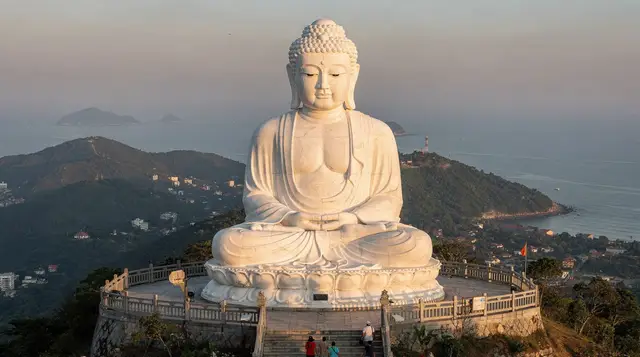
Wat Chalong sits close enough to several other sights that almost nobody visits it in isolation. The Big Buddha on Nakkerd Hill is a roughly 20-minute drive away and pairs naturally as a single half-day loop — most guided tours, including the one above, combine the two.
Chalong Pier itself, a few minutes further, is worth a stop if you’re booking a boat trip to the Similan Islands or a private longtail, since many operators depart from there. If you want the temple without the crowds, aim for opening time; if you’re happy trading quiet for convenience, folding it into a half-day city tour with Phuket Old Town is the more time-efficient option.
Half-day viewpoint, Big Buddha and Wat Chalong tourWhat Wat Chalong doesn’t offer
It’s worth being direct about what this stop isn’t. There’s no meditation retreat, no monk-chat program, and no quiet forest setting — for that kind of experience, look at dedicated meditation sessions instead, covered in temple etiquette in Thailand. The grounds can feel more like a busy public square than a contemplative space, particularly around midday when several tour buses overlap. If a hushed, empty temple is what you’re after, Wat Chalong on a Saturday afternoon will disappoint; Wat Chalong at 7:30am on a weekday is a different, much calmer place.
Busy periods worth planning around
Beyond the daily 10–11am tour-bus rush, a handful of annual events bring far larger crowds than any ordinary day. Chinese New Year, celebrated widely by Phuket’s large Chinese-Thai community, sees a noticeable spike in visitors making offerings, and the temple can feel closer to a local festival than a typical sightseeing stop. Songkran, Thailand’s April new year, brings a different kind of crowd — Thai families visiting temples as part of the holiday’s merit-making traditions, alongside the water-throwing celebrations happening elsewhere on the island (covered in Songkran in Phuket).
Weekends generally run busier than weekdays year-round, and Thai public holidays tied to Buddhist observances (full-moon days in particular) draw more local devotees than the average Tuesday. None of this makes Wat Chalong a bad choice on a busy day — it simply changes the pace and atmosphere from a quiet architectural visit to something closer to being part of an active local occasion, which some visitors find more interesting, not less.
A note on donations and how they’re used
The donation boxes inside the chapels and near the chedi aren’t performative — funds go toward temple upkeep, community welfare projects the temple supports, and in some periods, disaster relief efforts the temple has historically organised for the local community. There’s no fixed suggested amount and no pressure applied by temple staff; Thai visitors typically leave anywhere from a few baht up to several hundred, depending on personal means and the specific occasion.
As a visitor, a note of a similar scale to what you’d leave at a collection box in any place of worship at home is a reasonable guide — the amount matters far less than the fact that it’s optional and unsolicited. If you’d rather support the temple in a non-monetary way, buying firecrackers or gold leaf from the entrance stalls achieves much the same thing, since that spending flows back into the same local economy of vendors and shrine upkeep that donations do — a small, direct way to contribute without needing to work out an appropriate cash amount in an unfamiliar currency.
Comparing Wat Chalong to Phuket’s other temples
Phuket has roughly 40 Buddhist temples, and Wat Chalong isn’t automatically the most beautiful or the most historic — it’s simply the most significant to local devotees, and by extension the most visited. If striking scale is what you’re after, the Big Buddha guide covers the 45-metre marble statue on Nakkerd Hill, visible from much of south Phuket.
If architecture and streetscape matter more than any single religious site, Phuket Old Town and its smaller neighbourhood shrines offer a quieter, less touristed version of temple-going. Wat Chalong’s specific draw is its living history — the Luang Pho Chaem statue and the Ang Yi Rebellion story aren’t replicated anywhere else on the island, which is why it remains the reference point even for visitors who’ve seen several other temples first.
Where to stay if Wat Chalong is a priority
Wat Chalong sits inland, roughly equidistant from several parts of the island, so no single beach base gives you a dramatically shorter drive. Rawai and Chalong itself are the closest bases, both quieter and more residential than Patong, with the temple a 10–15 minute drive away. From Kata Beach or Karon it’s closer to 20–25 minutes, and from Patong or the west-coast resorts further north, budget 30 minutes or more. See where to stay in Phuket for a fuller breakdown by neighbourhood if temple access is one factor among several in your decision.
Fitting Wat Chalong into a short trip
If you’re only in Phuket for a few days, Wat Chalong is one of the easier cultural stops to slot in without derailing a beach-focused schedule, since a visit rarely needs more than half a morning. It appears as a natural add-on in most of the island’s 3-day and 5-day itineraries, typically paired with the Big Buddha and a stop in Old Town on a single cultural day, leaving the rest of the trip free for beaches and boat trips. For a broader sense of how much time culture-focused sightseeing deserves relative to everything else Phuket offers, see how many days in Phuket.
Frequently asked questions about Wat Chalong
Is Wat Chalong free to visit?
Yes. There’s no admission fee, though small donations are welcomed at the chapels and the main chedi, and most visitors buy firecrackers, gold leaf or flowers from the entrance stalls.
How long should I spend at Wat Chalong?
Most visitors need 45 minutes to 1.5 hours to see both chapels, climb a level or two of the chedi, and browse the stalls. Add more time if you’re there during a firecracker-heavy weekend or a festival.
What should I wear to Wat Chalong?
Shoulders and knees covered, shoes easy to slip off. Borrowable sarongs are usually available at the entrance, but don’t rely on stock being available — dress appropriately before you arrive.
Why do people set off firecrackers at Wat Chalong?
It’s a form of merit-making and thanks, often tied to a wish that was granted. The designated firecracker area is roped off near the car park; it’s loud and sudden, so be ready for it.
Can I combine Wat Chalong with the Big Buddha in one trip?
Yes, and most people do — they’re about 20 minutes apart by road, and several half-day tours pair the two along with Old Town.
Is Wat Chalong worth visiting if I’ve already seen other Thai temples?
It’s less about architectural novelty and more about the Luang Pho Chaem story and the fact that it’s still an active, locally significant place of worship rather than a museum piece — that’s the main draw over a purely scenic temple stop.
Do I need a guide to understand what I’m seeing?
Not strictly, but a guide adds real context on Luang Pho Chaem’s history and the significance of specific statues and murals that aren’t explained on-site with much English signage, particularly around the chapel interiors where signage is limited or Thai-only.
tours.culture-temples
Verified deep-linked GetYourGuide tours. Book through these links and we earn a small commission at no cost to you.
These are our own photographs of Phuket, not the operator's pictures of this tour — open the tour page to see those.