The closure is the single fact you need to know first
Before anything else about the Similan Islands — the diving, the granite boulders, the powder-white beaches — one fact overrides all of it: the national park is closed to every visitor from mid-May to mid-October each year. This isn’t a soft recommendation or a seasonal quiet period the way monsoon slowdowns work elsewhere on Thailand’s coasts; it is a hard, enforced closure, and no operator can legally run trips into the park during those months, no matter what a booking site might otherwise suggest. The closure exists to let the coral reefs, beaches and surrounding marine ecosystem recover from both the physical battering of the southwest monsoon and the cumulative pressure of the tourist season that precedes it.
If your trip falls between mid-May and mid-October, the Similan Islands are simply not an option, and any itinerary built around them needs a different destination for those dates — Racha Islands and Coral Island both stay open year-round and are the standard substitutes tour operators offer during Similan’s closed season. Outside that window, roughly mid-October through mid-May, the park is open and running at full capacity, and this is genuinely one of the best diving and snorkelling destinations reachable from Phuket.
Why the Similans have this reputation
The Similan Islands are a chain of nine granite islands rising out of the Andaman Sea, numbered rather than named in the local convention (Island 4, Island 8 and so on, alongside their Thai names), roughly 60 to 90 kilometres from Phuket depending on departure point. What sets them apart from the limestone-karst islands elsewhere in the region is the underlying geology: smooth granite boulders, some the size of houses, stacked along the shoreline and continuing underwater, creating a different kind of dive and snorkel terrain than the coral-and-cliff scenery further south.
Underwater visibility here regularly exceeds what’s typical elsewhere on Phuket’s dive circuit, often reaching 20 to 30 metres in good conditions, and the coral coverage across much of the park remains genuinely healthy — a direct result of the closure system that gives reefs an annual recovery window most heavily visited dive destinations never get. Marine life sightings are a real draw beyond the coral itself: reef sharks are a regular sighting on many dives, sea turtles turn up reliably enough that most divers see at least one over a multi-dive trip, and the deeper sites around the northern islands occasionally produce manta ray or even whale shark encounters, though neither is guaranteed on any single visit.
Diving at the Similans
For certified divers, the Similans are widely regarded as the best diving accessible from Phuket, and one of the better dive destinations in Thailand overall. Sites range from shallower boulder formations suited to newer divers to deeper walls and swim-throughs for more experienced ones, and most day-trip dive operators run two or three tanks across a single day, spread across two or three different sites to vary depth and terrain.
Book the full-day Similan Island scuba diving tripA single day trip only samples a fraction of what the park offers, and serious divers frequently choose a multi-day liveaboard instead — a boat that sleeps aboard and moves between sites over two to four days or more, reaching islands and dive sites too far north for a single-day round trip from the mainland to cover. If diving is the main reason for your trip, our Similan liveaboard guide explains how liveaboards compare with day trips and what a multi-day itinerary typically includes.
Snorkelling without a certification
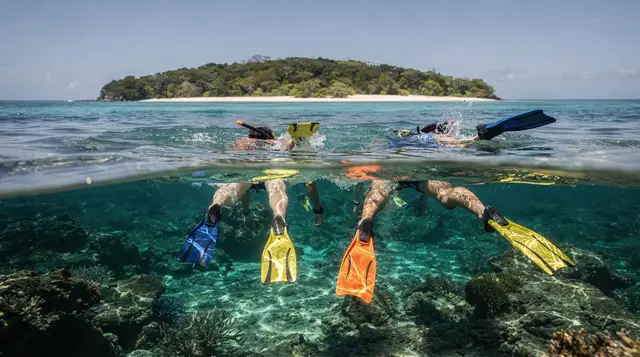
You don’t need a diving certification to see a meaningful amount of what makes the Similans worth the trip — much of the shallower reef and boulder terrain sits well within snorkelling depth, and several of the day-boat itineraries are built specifically around snorkelling stops rather than scuba diving. Visibility at snorkel depth is typically excellent in the dry season, and sightings of reef fish, occasional turtles and healthy coral are common even without going below the surface.
Reserve the speedboat snorkel tour to the Similan IslandsFor a full-day itinerary that combines several snorkel stops with beach time on one of the islands rather than focusing purely on the water:
See the Similan Islands day tripIf you’re deciding between diving and snorkelling for this trip specifically, our snorkelling vs diving in Phuket guide walks through what each actually involves and which suits a first-timer better.
Getting there: Khao Lak and Thap Lamu, not Phuket directly
Most Similan Islands trips do not depart from Phuket’s own piers. Thap Lamu, a small port roughly 90 minutes north of Phuket by road near the town of Khao Lak, is the closest mainland departure point to the islands, cutting the boat crossing to around an hour or so depending on conditions and boat speed. Khao Lak itself, a low-key beach town on the mainland coast, has become the de facto base for Similan trips generally — many operators are headquartered there rather than in Phuket, and travellers doing a dedicated Similan trip sometimes base themselves in Khao Lak for a night rather than commuting from Phuket both ways in a single very long day.
Book the Similan Islands day trip by speedboatBooking a Similan trip “from Phuket” almost always means a hotel pickup that drives you to Thap Lamu or a similar mainland port before the boat departs — factor in roughly 1.5 to 2 hours of road transfer each way on top of the boat crossing and the time on the water itself. It makes for a long day: pickup times are often before dawn, and return to your Phuket hotel can run into the early evening. Travellers based in Khao Lak itself skip most of that transfer time and get a meaningfully shorter day as a result.
Liveaboards versus day trips
A day trip covers the basics well and suits most travellers who want a taste of the Similans without committing extra nights or a larger budget to it. A liveaboard is the better choice specifically for certified divers chasing a fuller list of dive sites, better odds at rarer sightings like manta rays, and diving at times of day — early morning, sometimes night dives — that day boats simply can’t offer given their fixed return schedule. Liveaboards run at a noticeably higher price point and require more planning ahead, since berths on the better-regarded boats sell out well in advance during peak season, particularly around December through February.
Planning around the closure
Because the closed season is fixed and non-negotiable, it’s worth checking it against your travel dates before building any part of a Thailand itinerary around the Similans. If your trip lands outside mid-October to mid-May, treat the islands as unavailable rather than hoping an exception applies — plan diving or snorkelling time around Racha Islands, Coral Island or Phi Phi Islands instead, all of which run year-round.
For a wider look at how the Similans compare against Phuket’s other major island trips, see our Phi Phi vs Similan Islands guide, and for general trip timing across the whole island, our best time to visit Phuket guide covers how the Similan closure fits into the wider seasonal picture. If a diving-focused trip is the plan, our Phuket diving week itinerary is built around exactly this kind of visit.
Which islands day trips actually visit
With nine numbered islands spread across the park, no single day trip covers all of them, and it’s worth knowing roughly what a standard itinerary includes before booking. Island 8 (Koh Similan) and Island 4 (Koh Miang) are the two most consistently visited on day-trip itineraries, home to the park’s best-known granite viewpoints and the powder-soft beaches most photographs of the Similans actually show.
Island 8’s Sail Rock viewpoint, reached by a short but genuinely steep scramble over smooth granite boulders, is one of the more physically demanding short walks on any Phuket-area day trip, and rewards the climb with a sweeping view back over the bay and neighbouring islands. Island 4 hosts the park’s visitor centre and camping area, and its two adjoining beaches offer some of the calmest, clearest water in the park for a relaxed swim between dive or snorkel stops.
Liveaboard itineraries typically range further north into the park, reaching sites and islands day trips can’t cover in a single round trip from the mainland, including Koh Bon and Koh Tachai, both known among divers for a higher chance of manta ray sightings than the more accessible southern islands.
Costs and what’s typically included
A standard day trip from Khao Lak or with hotel pickup from Phuket generally runs somewhere in the range of 2,500–4,500 B (roughly 70–130 $) per person for a snorkelling itinerary, with National Park entry fees, lunch, snorkelling gear and hotel transfers usually included, though it’s worth confirming exactly what’s bundled before booking since practices vary between operators.
Diving day trips cost more, typically 4,500–7,000 B (130–200 $) or higher depending on the number of tanks and whether equipment rental is included, and a National Park entrance fee is charged separately from the tour price in many cases — factor in an extra few hundred baht for this on top of whatever the tour itself costs. Multi-day liveaboards run considerably higher, often from around 15,000 B (430 $) upward for a shorter trip to well over 40,000 B (1,150 $) for longer, more comfortable itineraries with better dive counts.
Frequently asked questions about visiting the Similan Islands
When exactly do the Similan Islands close each year?
The park closes from mid-May and reopens in mid-October, though the precise dates can shift by a week or two year to year depending on sea conditions and official park decisions. If your trip falls near either edge of that window, it’s worth checking current status with an operator rather than assuming the standard dates apply exactly.
Can beginners dive at the Similans?
Yes. Many of the shallower boulder sites suit newly certified or even first-time trial divers under instructor supervision, while the deeper walls and swim-throughs are better suited to more experienced divers. Most day-trip dive operators structure their sites to accommodate a mixed-experience group.
Do I need my own snorkelling gear?
No — snorkel, mask and fins are standard inclusions on nearly every day-trip package, along with a life jacket. Bringing your own mask is worth it only if you have a specific fit preference or prescription lenses fitted; otherwise, rental gear is perfectly adequate for a day trip.
Is it better to go from Phuket or from Khao Lak?
Khao Lak is closer to the park and cuts out the long road transfer that a “from Phuket” booking requires, resulting in a shorter overall day. If your trip is Phuket-based and a Khao Lak stay isn’t practical, a from-Phuket tour still works fine — it simply means an earlier pickup and a later return.
Are there sharks in the Similan Islands?
Reef sharks, generally small and not a safety concern for divers or snorkellers, are a fairly regular sighting on Similan dives and occasionally visible to snorkellers in shallower water. They’re one of the reasons the park has the diving reputation it does, alongside the coral and granite scenery.
What’s the difference between a day trip and a liveaboard, practically speaking?
A day trip means an early pickup, a long transfer to Thap Lamu or Khao Lak, a boat crossing, several hours of diving or snorkelling across two or three sites, and a return the same evening — all in a single, long day. A liveaboard means sleeping aboard the boat itself for two to four nights or more, waking up already moored at a dive site, and covering considerably more of the park’s northern islands and dive sites than a single-day round trip ever could reach.
Is seasickness a concern on the crossing?
It can be, particularly on choppier days even within the official open season, since the crossing from Thap Lamu covers open water rather than the sheltered channels used for some closer island trips. Travellers prone to motion sickness are generally better served by a larger, more stable boat than a smaller speedboat, and taking standard seasickness precautions before departure is a reasonable idea if you know you’re susceptible.
Are there facilities on the islands themselves?
Basic facilities exist on a couple of the more visited islands, including toilets and a small food and drink concession near the park’s visitor centre on Island 4, but don’t expect resort-level infrastructure — camping is the only overnight option within the park itself, and even that requires advance arrangement through the park authority rather than a standard tour booking.
Combining a Similan trip with the rest of your stay
Given the length of a Similan Islands day — often a pre-dawn pickup and a return well into the evening — most travellers treat it as a single, dedicated day within a longer Phuket trip rather than trying to pair it with anything else on the same date. It sits more comfortably within a week or longer itinerary that has room to absorb one particularly long day without disrupting the rest of the schedule; on a short three- or four-day trip, the Similans can end up costing a disproportionate share of your limited time once travel to and from Thap Lamu is factored in.
Our Phuket diving week itinerary and 10-day Phuket itinerary both build in the kind of buffer that makes a full Similan day work without crowding out beach time or other activities elsewhere on the island.
For travellers whose dates fall inside the closure and who still want a comparable diving or snorkelling experience, it’s worth reading how Racha Islands and Coral Island compare — neither matches the Similans’ visibility or scale, but both offer a legitimate half-day or full-day alternative that doesn’t require the long transfer to Khao Lak.