Phuket's quietest beaches, away from the Patong crowds
Which Phuket beaches actually stay quiet?
Mai Khao, Nai Yang and Nai Thon on the north coast, Ao Yon near Cape Panwa in the south, and Freedom Beach if you're willing to hike or pay for a longtail. All four regularly have long stretches of sand with almost nobody on them, even in high season.
What “quiet” actually means on an island this developed
Phuket is not an undiscovered island. Roughly ten million visitors land at HKT airport in a normal year, and most of them spend their beach time on four strips of sand: Patong, Karon, Kata and Bang Tao. Quiet, here, doesn’t mean empty like a desert island — it means a beach where you can put a towel down without negotiating personal space with a jet ski rental stand, a massage mat and three other groups, and where nobody is trying to sell you anything every few minutes.
The quiet beaches on this list earn that reputation for one of three reasons: they’re geographically inconvenient (north of the airport, a boat ride away, or down a track that doesn’t show up well on ride-hailing apps), they have less swimmable water so tour operators route around them, or they simply never got built up the way the west-coast strip did. None of that makes them better beaches in absolute terms — some have rougher sand, patchier shade or no amenities at all — but if the goal is fewer people, they deliver.
The north-coast stretch: Nai Yang, Nai Thon, Mai Khao and Layan
North of Bang Tao and the Laguna resort strip, Phuket’s west coast keeps going for another 15 kilometres before it reaches the airport, and this stretch is where the island’s quietest sand sits.
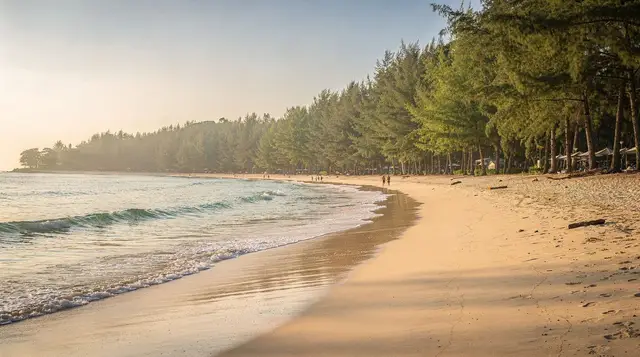
Nai Yang backs onto Sirinat National Park, which keeps large-scale resort development off most of the beachfront. Casuarina pines line the back of the sand and provide shade that most Phuket beaches lack. A shallow reef sits offshore, which flattens the surf for a good part of the year and makes this the most swimmable of the quiet beaches — though the same monsoon-season currents apply here as anywhere on the west coast, and there is no regular lifeguard presence.
A short row of open-air seafood restaurants at the southern end serves grilled fish with feet in the sand, and this is also one of the closer beaches to Phuket airport, useful if you’ve got a late flight and want a last few hours by the water.
Nai Thon, a couple of kilometres south, is smaller and even less developed — a single access road, a scattering of small restaurants, and long empty patches of sand on weekdays. The water here can carry a stronger undertow than Nai Yang, so treat any red flag seriously.
Mai Khao is the island’s longest beach — around 11 kilometres — and also its emptiest, because almost none of it is realistically swimmable. The seabed drops fast and the undertow is powerful most of the year, which is exactly why it isn’t developed with beach clubs and isn’t the kind of place you go to swim laps. What it does offer is space: you can walk for twenty minutes and not pass another person, watch planes land at HKT from directly under the flight path near the northern end, and, from November to February, spot the tracks of nesting sea turtles, a species this beach is protected for. Go for the walk and the solitude, not for a swim.
Layan, tucked just north of the Laguna complex, is short — a few hundred metres of sand — but quieter than its Bang Tao neighbour because it sits slightly apart from the main resort row. It gets busier at weekends with Phuket residents, which is itself a decent sign: locals don’t picnic on beaches that feel unsafe or unpleasant.
The south-coast quiet corner: Ao Yon and Cape Panwa
On the other side of the island, past Chalong and the Big Buddha, the coastline around Cape Panwa sits well off the main tourist circuit. Ao Yon (also written Ao Yon or paired with nearby Khao Khad) is a narrow beach with calmer water than the west coast, sheltered by the cape from the worst of the monsoon swell, and rarely visited by anyone other than people staying at the handful of resorts nearby. It’s not a swimming destination the way Kata is — the sand is coarser and the beach itself modest — but it’s genuinely calm, both in terms of crowds and water.
Cape Panwa itself is more about the peninsula than a specific beach: quiet lanes, an aquarium, sea views back toward Phuket Town, and none of the beach-vendor traffic of the west coast. It works better as a half-day of quiet than as a primary beach day.
Freedom Beach: quiet, but not secret
Freedom Beach gets mentioned constantly in “hidden beach” round-ups, and it is genuinely more scenic than most quiet options — a curve of white sand between headlands, backed by forest, with clearer water than the main west-coast beaches. But it isn’t secret: a steady flow of longtail boats brings visitors over from Patong through the late morning, and by early afternoon it can feel almost as busy as the beach you were trying to avoid. Our full guide to getting to Freedom Beach covers both access routes — boat and the steep coastal trail — along with the entry fee and why there’s no bus or taxi option.
What you give up by going quiet
Every quiet beach on this list trades something for its lack of crowds, and it’s worth being honest about what.
| Beach | What you give up | What you get |
|---|---|---|
| Nai Yang | Nightlife, big resort infrastructure | Shade, a shallow reef, airport proximity |
| Nai Thon | Amenities, food options | Genuine solitude on weekdays |
| Mai Khao | Safe swimming most of the year | Long empty sand, turtle nesting season |
| Layan | Size — it’s a short beach | Calm water, local weekend crowd (a good sign) |
| Ao Yon | Beach quality, sand texture | Sheltered, calm water, almost nobody around |
| Freedom Beach | True solitude midday | Scenery, clearer water than the west coast strip |
The recurring trade-off is safety infrastructure. None of these beaches has the lifeguard coverage — patchy as it is even on Patong and Karon outside peak season — that comes with heavier tourist traffic. If a beach has fewer people, it also has fewer people to notice if something goes wrong. Read the rip current and beach safety guide before you swim anywhere on the west coast, quiet or not, and treat a red flag on an empty beach exactly as seriously as one on a crowded beach — arguably more, because there’s nobody nearby to help.
Getting there without a group tour
None of the quiet beaches sit on Phuket’s main songthaew (shared truck-taxi) routes in the way Patong and Karon do. Realistically, you need your own transport. A rented scooter is the cheapest and most flexible option — see the scooter rental guide for legal requirements and insurance traps — or a Grab car booked one-way, since flagging a ride back from a quiet beach isn’t always reliable. Our getting around Phuket guide breaks down the full range of transport options if scooters aren’t for you.
Nai Yang and Nai Thon are roughly 30–40 minutes from Patong by road; Mai Khao is closer to 45 minutes, near the airport; Ao Yon is about 30 minutes from Chalong and closer to an hour from Patong.
When to go for maximum solitude
Even quiet beaches have relative peaks. Weekday mornings before 10am are consistently the emptiest window, before day-trippers and, on Layan and Ao Yon, local weekend visitors arrive. December through February — Phuket’s high season — brings more visitors everywhere, including the quiet beaches, though they still stay far calmer than the west-coast strip. The rainy season, roughly June through October, is genuinely the quietest stretch on all of these beaches, with the trade-off of less predictable weather and, on the exposed west-coast beaches, rougher surf. If you’re planning a trip specifically around uncrowded time, our avoiding crowds in Phuket piece goes deeper on timing.
Taking quiet further: islands instead of beaches
If a quiet beach on the mainland still isn’t quiet enough, the next step is a boat. A day trip to Koh Yao Noi — the low-key island sitting between Phuket and Krabi — swaps traffic and vendors for fishing villages and rubber plantations, at the cost of a longer transfer.
Closer in, a half-day out to the Racha Islands with a snorkelling boat trip gets you clearer water than anything on the mainland coast, and a private longtail to Coral Island is a shorter, cheaper version of the same idea if you’d rather stay close and skip the bigger crossing to Koh Yao Noi.
None of these are silent, empty islands either — Coral Island in particular gets crowded with day-trip boats by midday — but they thin out the mainland crowd by definition, since getting there takes effort most beach tourists never bother to make.
A realistic itinerary for a quiet-beach day
If you want to structure a full day around avoiding crowds rather than bolting a quiet beach onto a busier trip, here’s a sequence that works reasonably well from a Patong or Kata base:
- Leave by 8am, before the day’s heat and the day-trip traffic build up.
- Head north to Nai Yang or Nai Thon for a morning swim and breakfast at one of the beachfront restaurants.
- Continue up to Mai Khao for a walk along the empty sand — bring water, since services thin out fast north of Nai Yang.
- Loop back south by mid-afternoon before the roads around the resort strips clog with returning day-trippers.
For a shorter version that fits into a broader trip, our 7-day Phuket itinerary blocks in a north-coast half day alongside the main west-coast stops, if you’d rather not dedicate a full day to it.
What to pack when there’s no 7-Eleven nearby
The convenience-store-on-every-corner reality of Patong and Kata does not extend to Mai Khao, Nai Thon or Ao Yon. Pack more water than you think you need — Phuket’s heat is genuinely dehydrating even for a few hours on the sand — along with reef-safe sunscreen, since several of these beaches sit near protected coastline where mineral sunscreen is the more responsible choice even where it isn’t strictly enforced.
Bring small-denomination cash; the family-run restaurants near Nai Yang and the rare vendor on Ao Yon are not set up for cards. A basic first-aid kit is worth having too, precisely because these beaches don’t have the vendor density that on a busier beach would mean help or a pharmacy is a two-minute walk away.
How locals actually use these beaches
Watching how Phuket residents use the quiet beaches is a decent guide to which ones are genuinely pleasant rather than just empty. Layan and the Cape Panwa stretch around Ao Yon see real weekend traffic from Phuket Town families — groups setting up a mat, bringing their own food, staying for hours rather than the quick look-and-leave pattern of a tour-bus stop. That’s a meaningfully different pattern from a beach that’s quiet because there’s nothing to do there. Mai Khao, by contrast, draws locals mostly for the long beach walk and for the turtle-nesting season rather than for a swimming day — a useful signal that its main value is scenery and space, not swimming.
Accommodation near the quiet beaches
Staying directly on or near one of the quiet north-coast beaches is a realistic option, not just a day-trip destination — a handful of resorts sit along Nai Yang and Mai Khao specifically because of their national park backdrop and proximity to the airport, which suits arrival or departure nights particularly well.
The south-coast quiet corner around Cape Panwa has fewer beds overall but tends toward quieter, more spread-out resorts rather than the dense hotel rows of Kata or Karon. If a full stay built around calm rather than nightlife appeals more than a single quiet-beach day trip, our where to stay in Phuket guide breaks down which areas suit that kind of trip.
Frequently asked questions about Phuket’s quiet beaches
Is Mai Khao Beach safe for swimming?
Not reliably. Mai Khao has a steep drop-off and a strong undertow for most of the year, and it is rarely patrolled. Locals use it for walking, kite flying and watching planes land at the airport more than for swimming. If you do go in, stay shallow and never swim alone.
Which quiet beach is best for a family with young kids?
Nai Yang is the safer pick of the quiet north-coast beaches — it has a shallow reef-protected shelf near the national park end and shade from casuarina trees along the back of the sand, though the water still needs the same red-flag caution as anywhere on the west coast. For a broader comparison of family-friendly sand, see best family beaches in Phuket.
Can I still get food and a sunbed on a quiet beach?
On Nai Yang and Mai Khao, yes, in a limited way — a handful of beachfront restaurants near the access roads rent chairs and sell drinks and simple Thai food. On Ao Yon and the far end of Nai Thon, bring your own water and snacks, because there may be nothing open.
Do quiet beaches cost anything to enter?
No Phuket beach charges entry, quiet or busy — all beaches in Thailand are public land by law. The only costs are transport to reach them, and a chair or umbrella rental if you want one. Our beach chairs and rules guide explains the pricing and the law behind it.
Is Freedom Beach worth the trip if I just want quiet sand?
It’s one of the more scenic options, but it’s not undiscovered — longtail boats bring steady traffic from Patong through the late morning and midday. Arrive at opening or in the last two hours before boats stop running for a genuinely quiet stretch.
Are there quiet beaches within walking distance of Patong or Kata?
Not really. Every beach directly adjacent to Patong, Karon and Kata carries the same crowds during the day. The nearest genuine escape from Kata/Karon is a scooter or taxi ride to Nai Harn’s quieter southern rocks, or a boat to one of the nearby islands.
tours.beaches
Verified deep-linked GetYourGuide tours. Book through these links and we earn a small commission at no cost to you.
These are our own photographs of Phuket, not the operator's pictures of this tour — open the tour page to see those.