A bay defined by limestone, not beaches
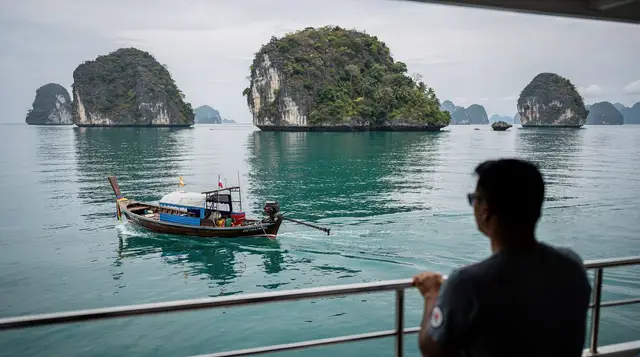
Phang Nga Bay is not a beach destination — it’s a marine national park of towering limestone karst formations rising directly out of sheltered, often glassy-calm water, north-east of Phuket across the strait toward the mainland province the bay is named after. The karsts themselves are the draw: sheer cliffs of grey and rust-streaked limestone, some riddled with tunnels and hidden lagoons (hongs, in Thai) that can only be reached by paddling through narrow sea caves at the right stage of tide. Most visitors see the bay as a single, fairly packed day out from Phuket rather than a place to base themselves, since there’s no real accommodation infrastructure inside the park itself.
The bay’s scale is larger than it looks in photographs — over a hundred islands and islets are scattered across it, and a single day trip only ever covers a handful of them. Tour operators have settled on a fairly standard rotation of highlights: sea-cave canoeing, a stop at Koh Panyee, and sometimes a paddle through mangrove channels, bundled into an itinerary that runs six to eight hours door to door from a Phuket hotel.
Koh Panyee, the village built on stilts
Koh Panyee is a fishing village built almost entirely on stilts against the base of a sheer limestone cliff, with no natural flat land to build on. Muslim fishermen from Indonesia and southern Thailand settled the site generations ago, and the community — now numbering several hundred residents — still lives largely from fishing and, increasingly, tourism, with restaurants, souvenir stalls and a mosque all built out over the water on the same timber-and-concrete stilt platforms as the houses.
It’s worth going in with realistic expectations: Koh Panyee is a genuine working village, but it also receives a heavy volume of day-tour traffic, and the walkways nearest the pier are lined with souvenir shops and seafood restaurants set up specifically for visitors. Walking a little further from the pier area reveals more of the everyday village — a school, a football pitch famously built on a floating platform because there was nowhere else to put one, and homes that aren’t part of the tourist circuit. Lunch is often included in tour packages and served at one of the restaurant platforms overlooking the bay; the seafood here tends to be a reasonable, if not exceptional, part of the day rather than a specific reason to visit.
Sea-cave canoeing through the karsts
The activity most tours are actually built around is sea-cave canoeing — paddling a small inflatable or hard-shell canoe, usually with a local guide steering from the back, through narrow tunnels carved through the base of the limestone cliffs. Some of these tunnels open into hongs, hidden internal lagoons enclosed on all sides by rock, accessible only by water and only at certain points in the tide cycle. Passing through the darker sections of tunnel, with the rock close enough to touch on either side and the ceiling sometimes low enough to require ducking, is the part of the day most visitors remember most vividly.
Because access to some hongs depends on tide height, timing on these tours is planned by the operator rather than flexible — a tour advertised for a specific island may substitute a different one on a given day if conditions don’t allow safe passage. This isn’t a sign of a badly run tour; it’s a sign of one paying attention to safety in tunnels where getting the tide wrong means being trapped, or scraping a canoe against the ceiling.
Book the Phang Nga Bay canoeing tour by big boatFor travellers who want the canoeing built around a fuller day with lunch included rather than a shorter add-on:
See the Phang Nga Bay kayaking and cave tour with lunchFor a deeper look at how sea-cave canoeing works, what to wear, and how to tell a rushed operator from a careful one, see our Phang Nga Bay sea canoe guide.
Mangroves and the wider bay
Beyond the karsts and Koh Panyee, parts of Phang Nga Bay’s shoreline are lined with dense mangrove forest, and some itineraries include a slower paddle or longtail-boat run through these channels — a quieter, greener contrast to the open water and limestone cliffs that dominate the rest of the day. Mangroves matter more here than scenery alone: they’re a nursery habitat for much of the marine life in the bay, and a working reminder that Phang Nga Bay is a protected ecosystem, not just a photogenic backdrop.
A small number of operators run itineraries built around six or seven of the bay’s better-known islands in a single, longer day, for travellers who want to see more of the park’s range rather than the standard three-stop rotation.
Reserve the 7 wonders of Phang Nga Bay 6-island tourDeparture points: Ao Po and Royal Phuket Marina
Most Phang Nga Bay tours leave from one of two points on Phuket’s east coast, both considerably closer to the bay than Phuket Town or the west-coast beaches. Ao Po Grand Marina, near the island’s north-east corner, is the shorter crossing to the bay and is used by a large share of the big-boat and canoeing tours. Royal Phuket Marina, further south near Phuket Town, serves a mix of day-tour operators and private charters, and tends to be more convenient if you’re staying around Phuket Old Town or the island’s east side rather than the west-coast beach towns.
Either way, factor in transfer time from your hotel: west-coast beach hotels in Patong, Kata Beach or Karon can mean 45 minutes to over an hour of road time each way before the boat even leaves the pier, since both marinas sit on the opposite side of the island. Most day-tour bookings include this hotel pickup as standard, which removes the logistics but adds to the overall day length — expect to be picked up early and returned by early evening.
Charter a full-day private speedboat to Phang Nga BayA private charter is worth considering if you’d rather set your own pace through the karsts and hongs rather than follow a group itinerary on a fixed schedule, particularly for photographers wanting to linger at a specific spot for the light.
How Phang Nga Bay compares to other boat trips
Phang Nga Bay is often paired in marketing with James Bond Island, which technically sits within the bay’s boundaries and is included on many of the same tours — see that page for what the famous islet itself is actually like once you get there.
It’s a genuinely different day out from Phi Phi Islands, which trades limestone scenery for beach time and snorkelling, or the Similan Islands, which are almost entirely about diving and snorkelling rather than sightseeing. If you’re trying to choose between Phuket’s major boat-trip destinations rather than doing more than one, our island hopping from Phuket guide breaks down which trip suits which kind of traveller.
What to bring and what to expect
Bring reef-safe sunscreen, a hat, and a dry bag or waterproof phone case if you own one — canoeing through low tunnels means a real chance of getting splashed or briefly soaked, particularly if the guide has to duck the canoe under a low section of rock. Sun exposure on the open water between stops is significant even on a cloudy day, since there’s little shade once you’re away from Koh Panyee’s covered walkways. Motion sensitivity is worth planning for on the boat transfers between islands, particularly if seas are choppier outside the November-to-April dry season; the canoeing itself, by contrast, happens in calm, sheltered water and rarely causes any discomfort.
For planning a wider Phuket trip that includes a Phang Nga Bay day, see our best day trips from Phuket guide and our 7-day Phuket itinerary, which allows a full day for this trip without crowding out beach time on the days either side.
How the karsts were formed
The limestone towers that define Phang Nga Bay are tens of millions of years old, formed from ancient marine sediment that was folded and lifted over geological time, then slowly eroded by rain, wind and seawater into the sheer-sided towers and hidden lagoons visible today.
The same limestone belt runs beneath much of this stretch of Thailand’s Andaman coast, surfacing elsewhere as the cliffs at Krabi’s Railay beach and the scattered islands further south, which is why the scenery here feels distinct from Phuket’s own granite-and-sand coastline just across the water. Some of the bay’s karsts are tall and narrow, like Koh Tapu; others are broader plateaus riddled with the internal caves and collapsed sinkhole lagoons — hongs — that sea-cave canoeing tours exist specifically to reach.
Much of Phang Nga Bay has been protected as a national park since 1981, a designation that predates the current wave of mass tourism and has helped preserve both the karst formations themselves and the surrounding mangrove ecosystem from the kind of unmanaged development seen elsewhere on Thailand’s coast. That protected status is also the reason access to certain hongs and cave systems is restricted or tide-dependent — park rules, not just navigational caution, govern where boats and canoes are permitted to go.
Photography in the bay
Phang Nga Bay rewards photographers more consistently than most single-day trips from Phuket, largely because of the scale and drama of the karst formations rather than any one specific shot. Early morning departures catch the karsts in softer, less harshly lit conditions, and haze tends to build through the middle of the day, especially in the hotter months, which can flatten the dramatic contrast between cliff and sky that makes the bay so photogenic in the first place.
A polarising filter cuts glare off the water noticeably if you’re shooting with a dedicated camera rather than a phone. Inside the sea caves and hongs, light drops fast, and a phone camera’s low-light performance is usually the limiting factor rather than the scenery itself — a small, water-resistant point-and-shoot or action camera handles the transition between bright open water and dim tunnel interiors considerably better.
Frequently asked questions about visiting Phang Nga Bay
Do I need to know how to swim to go sea-cave canoeing?
No. Canoes are steered by an experienced local paddler, and passengers generally remain seated throughout, wearing a life jacket at all times. Basic water confidence helps if you tip or want to get in for a swim at a stop, but swimming ability isn’t a prerequisite for the canoeing itself.
Is Phang Nga Bay suitable for young children?
Generally yes, for the standard big-boat and canoeing itineraries, though age and weight minimums can apply on some tours and it’s worth checking before booking with a young child. The boat transfers are calm within the sheltered bay, and Koh Panyee’s walkways are flat and easy for children to manage.
How is Phang Nga Bay different from a Phi Phi Islands trip?
Phang Nga Bay is about karst scenery, sea-cave canoeing and a cultural stop at Koh Panyee, with relatively little swimming or beach time built into most itineraries. Phi Phi Islands trips centre more on beaches, snorkelling and Maya Bay. Combining both into a single day isn’t realistic given the distances and different departure points involved.
Can I visit Phang Nga Bay independently without a tour?
Technically some access is possible by hiring a private longtail or speedboat directly at Ao Po or Royal Phuket Marina, but sea-cave canoeing through the hongs specifically requires a licensed local guide who knows the tide timing and permitted routes, so most independent-minded travellers still end up booking at least the canoeing portion through an operator.
What should I wear on a Phang Nga Bay tour?
Quick-dry clothing or swimwear under a t-shirt, since getting splashed while canoeing is likely. Closed-toe water shoes or sandals with a back strap help on the sometimes slippery boat decks and Koh Panyee’s timber walkways, and a light rain jacket is worth packing outside the driest months.
Budget and pricing expectations
A standard shared big-boat day trip covering Phang Nga Bay, sea-cave canoeing and Koh Panyee generally costs somewhere in the range of 1,800–3,200 B (roughly 50–90 $) per person, with National Park entry fees, lunch and canoeing usually bundled into the price. Faster speedboat itineraries that cover a similar route in less time typically cost more, reflecting the higher fuel use and smaller group sizes most speedboat operators run. Private full-day charters run considerably higher again, but let you set your own pace through the karsts and hongs, skip some of the queuing that busier shared-boat stops involve, and can be a reasonable option for a family or small group splitting the cost across several people.
Lunch served at Koh Panyee’s restaurant platforms is usually included in day-tour pricing, though drinks beyond water are typically an extra charge, and souvenir prices around the village pier run noticeably higher than equivalent items in Phuket Old Town’s markets — a predictable premium for a spot with essentially no shopping competition once your boat has already docked.
Combining Phang Nga Bay with other stops
Because a Phang Nga Bay day already runs six to eight hours door to door, most operators don’t attempt to combine it with a second major destination on the same day, and travellers hoping to also fit in Phi Phi Islands or the Similan Islands on the same trip should plan on separate days instead — the departure points, boat types and distances involved don’t overlap cleanly enough to make a combined itinerary practical. James Bond Island is the one exception, since it sits within the bay’s own boundaries and is already included on the large majority of Phang Nga Bay tours rather than requiring a separate booking.
If you’re building a longer stay around several of Phuket’s island and boat-trip destinations, spacing them across different days of a week-long trip works better than trying to compress them — both because of the physical length of each day and because the destinations themselves offer different enough experiences that back-to-back boat days can start to blur together rather than standing out individually. Our 10-day Phuket itinerary and 2-week Phuket itinerary both allow enough time to space major boat trips like this one out properly.