A famous rock, honestly described
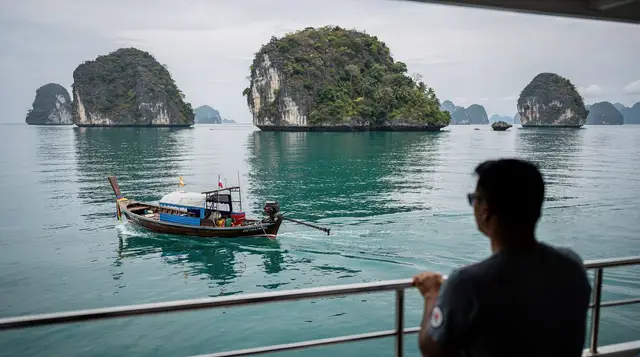
James Bond Island’s real name is Koh Tapu, meaning “nail island,” a reference to the thin limestone spike that leans out of the water at one end of a larger karst formation in Phang Nga Bay. It became globally famous after appearing in the 1974 film The Man with the Golden Gun, and the nickname stuck permanently — most tour listings, boat crews and even some maps now use “James Bond Island” more often than the actual Thai name.
It’s worth being upfront about what a visit actually involves, because the marketing photos can set expectations that don’t match reality. Koh Tapu itself is a narrow limestone pinnacle a few dozen metres tall, striking to look at but small in person, and it sits just offshore from a slightly larger karst island.
Most boats no longer dock directly at the small beach in front of it — the site sees enough daily boat traffic that many operators now stop nearby by water rather than adding to the crowding on the sand, and at busy periods in the day the beach and viewing area can be genuinely packed with visitors from dozens of boats arriving in overlapping windows. If you’re picturing a quiet landing on a private-feeling islet, recalibrate: this is one of the most visited single spots in the entire bay, and it looks it.
What actually makes the stop worth it
None of that means skip it — Koh Tapu earns its fame honestly, and seeing the rock formation up close, in the context of the surrounding karst cliffs, is a genuinely striking few minutes even with other boats nearby. The value of a James Bond Island stop comes from treating it as exactly that: a few minutes and some photos, not the centrepiece of the day. What actually makes the outing worth the trip is everything built around that single stop.
Most tours that include Koh Tapu pair it with sea-cave canoeing through the surrounding limestone tunnels — the same activity that anchors a standalone Phang Nga Bay day — and often a stop at Koh Panyee, the stilt-house fishing village built against a cliff face elsewhere in the bay. It’s this combination, not the rock itself, that turns a Koh Tapu stop into a full and worthwhile day out.
Book the James Bond Island and canoeing day tour by boatA version that folds in a full sea-canoe route through the karsts alongside the island stop, with lunch included, works well for a full day rather than a rushed half-day pass-through:
See the James Bond Island sea canoe tour with lunchTiming and crowd levels
Koh Tapu’s crowding follows a fairly predictable daily rhythm, since most Phuket-based day tours leave on similar morning schedules and converge on the bay within a few hours of each other. Late morning through early afternoon is consistently the busiest window; boats queue for space near the viewing area, and the beach fills with groups working through the same handful of photo spots. Speedboat tours, which move faster between stops than big-boat itineraries, sometimes reach the island earlier in the morning ahead of the bulk of the fleet, which is the closest thing to a quieter visit that’s realistically available on a standard day tour.
Reserve the James Bond Island and Phang Nga Bay tour by speedboatFor something genuinely different from the standard midday crowd, a small number of operators run a twilight sea-canoe route past the island timed for sunset and, on the right night, glowing bioluminescent plankton in the water — a distinct experience from the daytime version and one worth considering if you’ve already seen the island once and want a different kind of evening out on the bay.
Book the twilight sea canoe tour with glowing planktonGetting there
Nearly every visitor reaches James Bond Island as part of an organised Phang Nga Bay tour rather than travelling independently — there’s no scheduled ferry service to the island, and reaching it under your own arrangement would mean chartering a private boat, which most travellers don’t bother with given how comprehensively the standard tours already cover the site. Departures run from Ao Po Grand Marina or Royal Phuket Marina on Phuket’s east coast, the same points used for wider Phang Nga Bay trips, with hotel pickup typically included regardless of which coast you’re staying on.
What to skip and what to prioritise
If your time or budget only allows one bay-area trip, prioritise an itinerary that treats James Bond Island as one stop among several rather than a tour built entirely around it — those tend to be shorter, more rushed at the pinnacle itself, and skip the sea-cave canoeing that’s genuinely the better part of the day. Don’t expect to swim at Koh Tapu itself; there’s little beach access left given the boat traffic, and the better swimming and canoeing happens at the quieter hongs and lagoons elsewhere in the bay.
For a broader comparison of how a James Bond Island day fits against Phuket’s other major boat trips, see our island hopping from Phuket guide and our speedboat vs longtail boat guide, which explains the trade-offs between the faster, pricier speedboat tours and the slower big-boat itineraries that dominate this route.
If you’re deciding between a Phang Nga Bay-based day and the very different experience of Phi Phi Islands or the Similan Islands, our best day trips from Phuket guide lays out how the main options compare, and our 7-day Phuket itinerary shows where a day like this realistically fits.
The film that made it famous
The Man with the Golden Gun used Koh Tapu and the surrounding karst as the hideout of the film’s villain, and the crew’s brief shoot here left a permanent mark on how the island is known and marketed, even though the film itself is now several decades old and not one many younger visitors have actually seen.
Local operators leaned into the connection early, and the “James Bond Island” name has been the dominant one in tourism marketing for so long that plenty of visitors arrive not knowing “Koh Tapu” is the island’s real name at all. A small stretch of vendor stalls near the viewing area still sells film-themed souvenirs and photographs from the shoot, aimed squarely at visitors who grew up with the reference or are simply curious about the story behind the rock’s nickname.
It’s worth noting that the island’s fame is entirely about this one piece of cinema history layered onto a naturally striking limestone formation — there’s no other historical or cultural site at Koh Tapu itself, unlike Koh Panyee’s genuine village history elsewhere in the bay. That combination of natural drama and pop-culture recognition is exactly why it draws the crowds it does, and also why the actual on-the-ground experience — a packed viewing point and a quick stop — can undersell the appeal if you go in expecting more than a striking photo opportunity.
Photographing Koh Tapu
Because most boats now view the pinnacle from the water rather than landing directly beside it, the best photographs tend to come from positioning on your own boat’s deck rather than fighting for space on a crowded beach viewing area. Morning light generally works better than the flatter, harsher light of midday, and a wider-angle lens or phone setting captures the full scale of the pinnacle against the surrounding karst cliffs better than a tighter, zoomed shot. If your tour includes the sea-cave canoeing portion elsewhere in the bay, save some attention for those tunnels and hongs — they photograph just as well as Koh Tapu itself, with the advantage of far fewer other boats competing for the same angle.
Frequently asked questions about visiting James Bond Island
Can you still land on James Bond Island?
Landing options are limited compared with the past — many boats now stop offshore rather than docking at the small beach directly in front of Koh Tapu, largely due to the volume of daily visitor traffic. Some smaller or private-charter operators may still allow a brief landing depending on conditions and crowding on a given day, but it isn’t a guaranteed part of every tour.
Is James Bond Island worth visiting on its own, without the rest of Phang Nga Bay?
Not really. The pinnacle itself takes only a few minutes to see and photograph, and a tour built purely around that single stop misses the sea-cave canoeing and Koh Panyee village visit that make up the more substantial and memorable parts of a bay day. It’s worth going as part of a fuller Phang Nga Bay itinerary rather than as a standalone destination.
How crowded is it, really?
Very, particularly from late morning through early afternoon when the bulk of Phuket’s day-tour fleet converges on the site. Early-departure speedboat tours or the twilight canoe option are the two realistic ways to see a noticeably quieter version of the island.
Do I need a Phang Nga Bay tour or a specific James Bond Island tour?
In practice these overlap almost completely — nearly every tour marketed around James Bond Island includes stops elsewhere in Phang Nga Bay, and vice versa. The naming is largely a marketing choice by the operator rather than a meaningfully different itinerary.
Is the twilight plankton tour reliable?
Bioluminescent plankton sightings depend on conditions that vary night to night — water temperature, moon phase and recent weather all play a role — so it isn’t guaranteed on every departure. The sunset scenery and quieter evening atmosphere around the island make the tour worthwhile even on a night when the plankton display is muted.
How much does a James Bond Island tour cost?
Shared big-boat itineraries combining the island with canoeing and Koh Panyee typically run somewhere in the range of 1,800–3,500 B (roughly 50–100 $) per person, with National Park fees, lunch and hotel transfers usually included. Speedboat versions covering a similar route in less time generally cost more, and private charters more still, in exchange for a set-your-own-pace itinerary rather than a fixed group schedule.
Budget and pricing expectations
Because nearly every James Bond Island visit is part of a wider Phang Nga Bay itinerary rather than a standalone booking, pricing follows the same pattern as a general bay tour: budget shared-boat options at the lower end, faster speedboat departures in the middle, and private full-day charters at the top for travellers who want flexibility over cost.
Lunch is typically included on full-day itineraries, usually served either on board or at Koh Panyee’s restaurant platforms elsewhere in the bay, with drinks beyond water charged separately in most cases. Souvenir stalls near the Koh Tapu viewing area sell the expected range of film-themed keepsakes and postcards at prices a little higher than you’d find in Phuket Town, a fairly standard markup for a site with a captive, boat-delivered audience and no real shopping alternative nearby.
Setting realistic expectations before you book
The gap between how James Bond Island is marketed and what the visit actually feels like is the single most common source of disappointment among first-time visitors, and it’s worth addressing directly. Marketing photographs are almost always shot from angles and at times of day that minimise the crowd of other boats, and it’s easy to arrive expecting a quiet, cinematic moment alone with the pinnacle.
In practice, particularly across the late morning and early afternoon, you’re one of dozens of boats and a much larger number of people converging on the same small stretch of water and shoreline. That’s not a reason to skip it — the rock formation is genuinely worth seeing — but going in with accurate expectations, rather than the marketing version, makes for a better day than being caught off guard by the crowd.
The travellers who tend to come away happiest are the ones who treat Koh Tapu as a highlight within a longer, varied day rather than the entire point of the trip — pairing the brief stop at the pinnacle with unhurried time in the sea caves and hongs elsewhere in Phang Nga Bay, where the crowds thin out considerably and the scenery is, for many visitors, just as memorable as the famous rock itself.
That reframing matters most for anyone choosing between tour options at the booking stage. A cheaper, shorter itinerary that rushes to Koh Tapu, allows a few minutes for photos, and heads back tends to deliver exactly the underwhelming version of the visit that generates disappointed reviews — all crowd, no context, and none of the calmer canoeing or village time that rounds out a proper bay day. Paying a little more for a fuller itinerary that treats the island as one stop among several is consistently the better trade, and it’s the difference between remembering James Bond Island as a crowded photo stop and remembering it as one good moment within a genuinely worthwhile day on the water.
If you’re still deciding whether a bay-based day trip fits your itinerary at all, weigh it against the very different pace of a beach-and-snorkelling day at Phi Phi Islands or a dive-focused day at the Similan Islands — three of Phuket’s signature boat trips, each built around a different kind of day, and each better suited to a different type of traveller than the marketing for any of them tends to let on.
Whichever you choose, book with an operator that’s upfront about group sizes, boat type and exactly which stops are included, rather than one whose listing simply says “James Bond Island tour” with little further detail — the difference between a rushed itinerary and a well-paced one usually shows up in those specifics long before the boat ever leaves the marina.