Maya Bay visiting guide
Can you still swim at Maya Bay?
No. Since the 2022 reopening, swimming inside Maya Bay is banned to protect the reef; visitors walk in from Loh Samah Bay on a boardwalk for a timed slot on the sand only, and boats can no longer anchor in the bay itself.
Why Maya Bay isn’t the beach from the film anymore
Maya Bay, on Phi Phi Leh, is the cove made famous by The Beach in 2000 — and it nearly loved itself to death because of it. By the mid-2010s, up to 5,000 visitors a day and 200 boats were anchoring directly in the bay, and roughly 80% of the surrounding coral was damaged or dead. Thailand’s government closed it completely in June 2018. It reopened in January 2022 with a fundamentally different set of rules, and those rules — not the scenery, which is still spectacular — are what you need to plan around.
The rules that actually affect your visit
- Daily visitor quota. The park caps how many people can be on the beach at once and across the day; arrivals are staggered.
- Time-slot system. Boats are assigned a window rather than showing up whenever. Your tour operator’s slot, not your preference, decides when you’re there.
- Maximum time on the sand per group — typically around an hour, sometimes less if the beach is busy. This is not a lounging beach; it’s a look-walk-photograph stop.
- No swimming inside the bay. This is the rule that surprises people most. You can walk the sand and wade at the very edge under supervision in places, but swimming in Maya Bay itself is prohibited.
- No anchoring in the bay. Boats moor outside and passengers walk in.
- Annual closure window. The park closes Maya Bay itself for roughly two months a year (historically around August–September) to let the ecosystem rest, separate from the Similan Islands’ longer seasonal closure — check current dates with your operator before booking a late-summer date.
How you actually get to the sand: the back-door boardwalk
This is the single biggest change from the film-era image of Maya Bay. Boats used to nose directly onto the beach at the front of the bay. Now, every visitor arrives via Loh Samah Bay, the neighbouring cove on the back (east) side of the peninsula, and walks across a raised wooden boardwalk through the trees to reach Maya Bay’s sand. It’s a five-to-ten-minute walk, flat and shaded, but factor it into your “time at Maya Bay” — the boardwalk transit eats into your slot, not just the beach time itself.
Loh Samah Bay is worth knowing about in its own right: many operators build in a swim or snorkel stop there specifically because it’s calmer, less crowded, and swimming is actually allowed, unlike in Maya Bay proper.
The national park fee: pay this in cash, on the day
Maya Bay sits inside Mu Ko Phi Phi National Park, and the entrance fee is charged on top of whatever you paid for your tour — this is true across nearly every operator, from budget shared speedboats to premium charters. Expect around 400 THB (roughly $11) per adult and around 200 THB (roughly $6) per child, paid in cash, usually collected on the boat just before or after the visit. It’s rarely mentioned upfront in tour listings. Carry small baht notes; nobody on a rocking boat wants to make change for a 1,000 THB note.
Phi Phi Island and Maya Bay speedboat tourWhen to go to avoid the worst of the crowd
Time slots are assigned by the park authority to operators, so you can’t simply “choose” an off-peak visit the way you might at an open beach — but you can stack the odds by picking a tour that departs Phuket at the very first available time, typically 6:30–7am. Early slots tend to be calmer, with better light for photos and fewer boats queuing at the Loh Samah mooring. Trips that build in Maya Bay as their first stop of the day, rather than the last, are the ones worth booking. If your itinerary has Maya Bay scheduled for early-to-mid afternoon, expect the busiest version of the visit.
What the bay looks like today
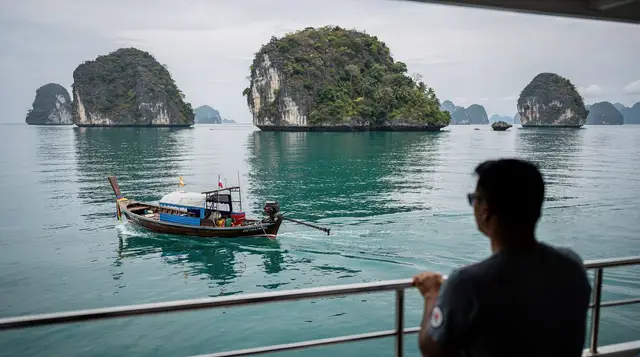
The water is still a striking turquoise-green against 100-metre limestone cliffs on three sides — that part of the postcard is real and hasn’t changed. What has changed is texture: you’re one group among several rotating through a marked, roped, ranger-monitored stretch of sand, not alone on a hidden cove. Coral recovery near the shoreline has been documented by park authorities since the ban on anchoring and swimming, and reef sharks have reportedly returned to the shallows in small numbers — worth watching for from the boardwalk, even though you can’t swim with them.
What’s included on a Maya Bay tour — and what isn’t
- Included on most tours: speedboat or big boat transport, life jacket, a guide, and usually a stop or two elsewhere in the Phi Phi group (Monkey Beach, Pileh Lagoon, Bamboo Island) since almost nobody sells a Maya-Bay-only trip.
- Not included: the national park fee (see above), and swimming time at Maya Bay itself, because that’s not offered anywhere at any price.
- Worth checking before booking: whether Maya Bay is the first or last stop, and how long the group’s actual time on the sand is — some budget tours quietly shorten it to fit more stops into the day.
For the full itinerary most Maya Bay visits are bundled into, see the Phi Phi day trip from Phuket guide.
Day trip to Phi Phi, Maya and James Bond islandsSpeedboat or big boat to reach Maya Bay
Both get you there; the difference is time and comfort, not access to the bay itself. A speedboat crosses in 45–75 minutes and gives a rougher, faster ride; a big boat or catamaran takes 1.5–2 hours but is steadier and usually comes with a proper lunch. See speedboat vs longtail boat for the full comparison of ride quality, and if seasickness is a concern, the big boat is the safer bet, especially outside the November–April dry season.
What to pack for Maya Bay specifically
- Cash in small baht notes for the park fee
- Reef-safe sunscreen or, better, a rash guard — you will not be swimming here so sun coverage on the walk and beach stop matters more than usual
- Sturdy sandals for the boardwalk, which can be uneven and slippery after rain
- A dry bag for your phone/camera on the speedboat leg
- Patience — this is a photo-and-walk stop, not a lounging beach
Who Maya Bay isn’t for
If your main goal is swimming in a famous bay, Maya Bay will disappoint you — that’s simply not permitted anymore. Beach clubs and swimmable coves like Freedom Beach or a private longtail trip to Racha Islands deliver what people usually picture when they imagine “the Beach movie experience.” Maya Bay today is best understood as a scenic, historically significant, heavily managed viewpoint-and-photo stop within a longer Phi Phi day trip — worth doing once for what it is now, not for what it used to be.
How Maya Bay fits into a wider Phi Phi day
Almost nobody books a Maya-Bay-only excursion — it’s sold as one leg of a longer Phi Phi day trip from Phuket that also visits Monkey Beach, Viking Cave and one or two snorkel stops around Bamboo Island or Pileh Lagoon. That matters for planning: if Maya Bay is the reason you’re booking at all, check where it sits in the running order before you pay. Operators that put it first, right after the morning pickup, tend to deliver the calmer, less rushed version described above. Operators that leave it for early afternoon are often working around their own boat traffic and lunch schedule rather than your experience of the bay, and that’s when the timed-slot system feels most like a queue.
It’s also worth deciding upfront whether you want a shared group boat or a private charter. A private longtail boat hire can sometimes secure a more favourable slot and lets you set your own pace for the rest of the day around Phi Phi Leh, at a meaningfully higher price than a shared speedboat seat.
Photographing Maya Bay within the rules
Tripods and drones are restricted or banned outright in the bay — check current rules with your operator, since enforcement has tightened since the 2022 reopening and rangers do confiscate equipment used without permission. Handheld photography is fine. The classic wide shot of the cliffs and turquoise water works best from the sand looking back toward the boardwalk treeline, away from the crowd clustered near the entrance point. Because your time on the beach is capped at around an hour including the boardwalk walk, decide before you land whether you’re prioritising photos, a slow look around, or both, since rushing between the two is the easiest way to feel like the visit was too short.
Comparing Maya Bay with Phuket’s other famous coves
If what you actually want is the classic “postcard cove you can swim in” experience that Maya Bay used to offer, it’s worth being honest that Maya Bay itself no longer delivers that. Freedom Beach, reachable by longtail from Nai Harn or a short walk from Patong, and Racha Islands further offshore both offer swimmable, scenic coves without the quota system. Neither has quite the sheer-cliff drama of Phi Phi Leh, but both let you actually get in the water, which for many travellers is the bigger deal-breaker than the crowd itself.
Etiquette at a heavily managed site
Maya Bay’s recovery is genuinely fragile and monitored — rangers patrol the beach and boardwalk, and the rules aren’t performative. Stay on the marked boardwalk rather than cutting through vegetation, don’t touch or stand on coral if you’re wading at the permitted edges near Loh Samah, and don’t attempt to swim in the bay even if the water looks empty and inviting when a ranger isn’t visible; fines apply and they’re enforced. Litter, including cigarette butts and bottle caps, gets carried out by rangers daily; take yours with you rather than assuming there’s a bin nearby, since facilities on the beach itself are minimal by design.
A short history worth knowing before you go
Maya Bay’s closure in 2018 was, at the time, one of the more dramatic moves any Southeast Asian government had made to protect a single tourist site — a full shutdown of a globally famous beach, with no fixed reopening date announced initially, driven by park biologists documenting near-total coral loss in the bay’s shallows.
The eventual reopening plan, developed with input from marine researchers, deliberately rebuilt the whole visitor flow around the bay rather than tweaking the old one: new mooring points outside the bay, the Loh Samah boardwalk, a hard visitor cap, and the swimming ban. It’s a genuinely unusual case of a tourist site being redesigned around ecological recovery rather than visitor convenience, which is part of why the current rules feel more restrictive than almost anywhere else on a typical Phuket itinerary.
What locals and boat crews say about the change
Ask a longtail captain who worked the Maya Bay run before 2018 and most will tell you the bay is calmer and, in their view, more pleasant to work now — less jostling for anchor space, less noise, and a system that’s at least predictable even if it caps numbers. That’s a genuinely different perspective from the disappointed-tourist framing that dominates a lot of online reviews written by people expecting the pre-2018 free-for-all. Both things can be true: the managed version is better for the reef and for the people who work there, and it is a more restricted, more scripted visit than what older photos and film clips promised.
A note on managing expectations before you go
Reading enough reviews of Maya Bay turns up a consistent split: visitors who arrive knowing exactly what the current visit involves tend to come away impressed by the scenery and relieved the reef looks healthier than they expected; visitors who arrive picturing an empty swimmable cove tend to come away disappointed regardless of how the day actually went. The gap is almost entirely about expectations set before booking, not the quality of the operator. Treat this guide’s description of the boardwalk, the time limit and the swimming ban as the baseline expectation, and the visit is far more likely to land as a highlight of your trip rather than a letdown.
Frequently asked questions about visiting Maya Bay
Is Maya Bay open in 2026?
Yes, under the quota and time-slot system introduced at its 2022 reopening. It does close for a seasonal rest period of roughly two months most years — confirm exact dates with your tour operator if you’re travelling in late summer.
Can you swim at Maya Bay?
No. Swimming inside the bay is banned to let the reef recover from anchor and foot-traffic damage. You can walk the beach during your allotted time slot.
How do boats reach Maya Bay if they can’t anchor in the bay?
They moor at neighbouring Loh Samah Bay, and passengers walk in on a raised boardwalk through the trees — about five to ten minutes each way.
How long do you actually get at Maya Bay?
Typically around an hour on the sand, sometimes less depending on how busy the day is and how the park authority is managing arrivals.
Is the national park fee included in tour prices?
Almost never. Budget around 400 THB (about $11) per adult and around 200 THB (about $6) per child, paid in cash on the day.
Is Maya Bay worth visiting given the restrictions?
For the scenery and the history, yes, once — the cliffs and water colour are still exceptional. If your priority is actually swimming somewhere beautiful, plan that at a different stop on the same trip, like Pileh Lagoon or Bamboo Island.
What’s the best time of day to visit Maya Bay?
The earliest available slot, generally tied to a 6:30–7am departure from Phuket, gives the calmest water and the fewest other boats queuing at Loh Samah.
Do I need a tour, or can I visit Maya Bay independently?
Practically, yes, you need a boat — either a group tour or a private longtail/speedboat charter from Phi Phi Don or Phuket. There’s no land access to Maya Bay.
tours.islands-boat-trips
Verified deep-linked GetYourGuide tours. Book through these links and we earn a small commission at no cost to you.
These are our own photographs of Phuket, not the operator's pictures of this tour — open the tour page to see those.