Scuba diving in Phuket for beginners
Can a complete beginner go scuba diving in Phuket?
Yes, through a Discover Scuba Diving (DSD) session, which is a short, instructor-supervised introduction that doesn't require any certification or prior experience — just reasonable health and comfort in water. It's a single day, not a course, and it doesn't qualify you to dive without an instructor afterward.
Trying diving and learning to dive are two different products
Phuket sells both a one-day taste of scuba diving and a multi-day path to a real certification, and the two get advertised in ways that make them sound more similar than they are. If you have a free day and want to know whether diving is for you, what you want is a Discover Scuba Diving (DSD) session — no course, no exam, no certification card at the end, just a supervised introduction. If you want to be able to dive independently with a buddy anywhere in the world afterward, you want a PADI Open Water course, which is a genuinely different commitment in time and structure. This guide covers the first option in depth; our PADI Open Water course guide covers the second.
What a Discover Scuba Diving (DSD) session actually involves
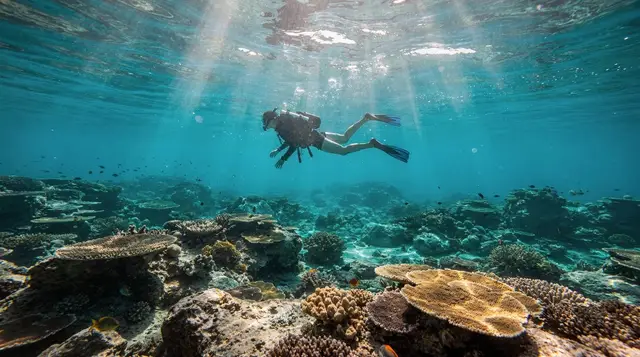
A standard DSD day starts with a short briefing on land or on the boat covering basic hand signals, how to clear your mask underwater, and what to do if something feels off. That’s followed by a shallow confined-water practice — either in a pool or a calm, sandy patch of sea — where your instructor checks you’re comfortable breathing underwater and controlling your buoyancy before taking you any deeper. Once that’s done, you do one or two open-water dives, almost always to a shallow depth (commonly capped around 12 metres), with an instructor directly alongside you the entire time, usually holding onto or guiding you rather than leaving you to swim independently.
a Discover Scuba Diving trip to Racha Yai island is a good example of the standard format — a full day trip built around the confined-water session and two guided dives at one of the clearer dive sites within reach of Phuket. For a slightly different version with more open-water time, two dives for non-certified beginners at Racha Yai follows a similar structure with an emphasis on maximising your actual underwater time rather than classroom time.
Some operators run DSD trips at Coral Island or combine it with a broader Racha and Coral Islands itinerary — a Racha and Coral Islands trip with a scuba beach dive keeps the confined-water part close to shore rather than on a rocking boat, which some first-timers find noticeably easier and less stressful.
What you don’t get from a Discover Scuba session
It’s worth being direct about the limits: a DSD session doesn’t certify you to dive without an instructor, it doesn’t count as any part of a PADI Open Water course unless your instructor specifically logs it as a “referral” dive toward one (ask if this matters to you), and it doesn’t give you access to dive sites that require certification, like deeper wrecks or drift dives with stronger currents. It’s a genuine, real dive — not a shallow snorkel pretending to be scuba — but it’s a taste, not a qualification.
Medical questions you’ll be asked before you’re allowed in
Every reputable operator in Phuket will have you fill out a standard PADI medical statement before your dive, regardless of how experienced you are. It asks about a list of conditions that can make diving genuinely risky: certain heart conditions, uncontrolled asthma, epilepsy, recent surgery, ear or sinus problems, and a handful of others. If you answer “yes” to any of the flagged questions, you’ll typically need a signed clearance from a doctor before the operator will let you dive — this isn’t optional paperwork, it’s a real gate, and dive shops that skip it aren’t ones you want to trust with your safety underwater.
Pregnancy is an automatic no for diving, and being significantly overweight or unfit for your body type can also be a reason an instructor declines to take you, since it affects both your air consumption and how safely they can assist you if something goes wrong. If you’re on medication, particularly anything affecting alertness or heart rate, mention it during booking rather than showing up and hoping it doesn’t come up — most issues are manageable with advance notice, far fewer are manageable on the spot.
How long to wait before flying after diving
This is one of the most commonly ignored safety rules by first-timers, and it matters. After scuba diving, your body carries dissolved nitrogen that needs time to clear before you’re exposed to the lower cabin pressure of a flight — going up too soon raises the risk of decompression sickness.
The generally recommended minimum is at least 18 hours after a single no-decompression dive, and dive organisations typically recommend waiting longer — commonly 18 to 24 hours or more — if you’ve done multiple dives or dived on consecutive days. This is a genuine medical guideline, not a suggestion, so if your flight home is the same day or the next morning as a Phuket dive trip, check the actual gap against your departure time before you book, and ask your dive operator directly what they recommend for your specific dive profile.
What a DSD day actually costs
Discover Scuba trips in Phuket typically run 2,500-4,500 B (about $70-130) per person for a full day including two dives, equipment, and a boat trip to a site like Racha Yai; prices vary based on how far the boat travels and whether lunch and hotel transfer are included. That’s usually more than a snorkeling day trip but less than a full certification course, reflecting the extra one-on-one instructor time a DSD session requires compared to a group snorkeling tour.
| Option | Typical duration | Typical price |
|---|---|---|
| Discover Scuba Diving (DSD), 2 dives | 1 day | 2,500-4,500 B (~$70-130) |
| Snorkeling day trip (no diving) | 1 day | 1,500-2,800 B (~$43-80) |
| PADI Open Water certification | 3-4 days | 12,000-16,000 B (~$340-460) |
Where beginners actually dive around Phuket
Racha Yai is the most common site for beginner dives — shallow, generally calm, and close enough to reach without eating up your whole day in transit. Coral Island is used for some shore-based confined-water sessions given its proximity to Phuket. More experienced beginners sometimes progress to slightly more challenging sites, but for a first dive, expect Racha or somewhere similarly sheltered rather than an open-water wreck or drift site. Our Racha Island day trip guide covers the logistics of getting there if you’re combining a dive trip with other activities.
Snorkeling as the lower-commitment alternative
If a full dive day — even a beginner one — feels like more than you want to commit to, snorkeling covers a lot of the same visual experience (reef fish, coral, clear water) without any equipment training or medical screening. Our best snorkeling spots guide and snorkeling vs diving comparison lay out honestly what you gain and lose by staying on the surface instead of going under with a tank.
What the confined-water session actually feels like
This is usually the part that decides whether the rest of the day goes smoothly, so it’s worth going into it unrushed.
For most first-timers, the confined-water practice — not the open-water dive itself — is the part that causes the most nerves beforehand, and it’s worth knowing what actually happens. Your instructor starts in shallow water where you can stand, walking you through breathing through the regulator while your face is still above the surface, then gradually easing you down until you’re fully submerged but able to stand back up at any point.
Skills like clearing water from your mask and recovering a regulator that’s slipped out of your mouth are practiced slowly and repeated until they feel routine, not rushed through once and left for the open water. If something feels wrong at any point, standing up and stopping is always an option in the confined-water stage — which is exactly why it happens before the boat heads out to open water rather than after.
Common fears and how instructors actually handle them
Fear of running out of air is the single most common worry beginners raise, and it’s addressed directly during the briefing: your instructor monitors your air supply throughout the dive, and DSD dives are kept shallow and short enough that running low is very unlikely under normal conditions.
Claustrophobia from the mask and regulator is the other common concern, and it’s exactly what the confined-water session is designed to work through gradually rather than spring on you all at once in open water. If you know in advance that either of these worries you, say so when you book — a good operator will spend extra time on exactly that concern during your confined-water session rather than rushing you toward the open-water dive on a fixed schedule.
Equipment you’ll actually use
A DSD session includes a wetsuit (usually a shorty or full 3mm suit, since Phuket’s water is warm year-round), a buoyancy control device (BCD) that the instructor largely manages for you, a regulator connected to a tank, a mask, and fins. You don’t need to own or bring any of this — it’s included in the price and fitted by the dive staff before you get in the water. If you wear glasses, ask about prescription mask inserts in advance, since standard rental masks don’t accommodate them.
Sizing matters more than people expect, particularly for the wetsuit and fins — a poorly fitted wetsuit lets in cold water and makes the whole experience less comfortable, while ill-fitting fins cause cramping over a longer swim. Arrive with enough time before departure to try on gear and swap sizes if something feels wrong, rather than discovering a problem once you’re already on the boat heading out to the dive site.
How this fits into a longer Phuket trip
A single DSD day works well as one activity within a broader stay rather than something to build an entire trip around — see our how many days in Phuket guide for how it fits alongside beaches, temples, and other day trips. If the try-dive goes well and you’re tempted to go further, a full PADI Open Water course is the next step, and some dive shops will credit a DSD dive toward it if you ask in advance.
For a broader look at how diving compares to other water activities on the island, our diving season in Phuket guide covers how conditions shift through the year, and our snorkeling vs diving comparison is worth reading if you’re still deciding which to try first.
Plan your DSD day with some slack either side rather than scheduling it on your first or last day in Phuket. Jet lag and travel fatigue make the confined-water session harder than it needs to be, and — as covered above — a same-day or next-morning flight after diving cuts it too close against the recommended no-fly window.
Weather can also shift a scheduled dive day at short notice, particularly outside the calmer November-April stretch, so a trip with a little flexibility built in copes far better with a last-minute reschedule than one where every day is already booked solid.
Travel insurance and diving
Check that your travel insurance policy actually covers scuba diving before you book — some standard policies exclude it entirely or cap the depth they’ll cover, and a DSD session’s shallow depth is usually within range but it’s worth confirming rather than assuming. See our travel insurance for Thailand guide for what to look for specifically.
Choosing an operator
Look for PADI or SSI affiliation (displayed on the boat, the shop, or the booking listing), small instructor-to-student ratios for DSD sessions — one instructor per one or two beginners is standard, more than that is a red flag — and clear answers to direct questions about depth limits, medical screening, and what happens if you’re not comfortable partway through. A shop that pressures you past a genuine hesitation, rather than slowing down or aborting the dive, isn’t one to trust with a first-timer.
Frequently asked questions about scuba diving in Phuket for beginners
Do I need to know how to swim to try scuba diving in Phuket?
Basic water comfort is expected — you don’t need to be a strong swimmer, but you should be relaxed in water and able to follow instructions calmly, since panic underwater is the main risk factor operators screen for during the confined-water session.
How deep do beginners dive on a Discover Scuba trip?
Typically to a maximum of around 12 metres, shallower than certified fun dives, and always with an instructor directly alongside you rather than diving independently.
Is Discover Scuba Diving safe for beginners?
Generally yes when run by a reputable, certified operator with proper medical screening and low instructor-to-student ratios. The main risks are the same ones any diving carries — barotrauma, decompression issues, panic — which is exactly why the medical questionnaire and confined-water check exist.
Can I fly the same day I go scuba diving in Phuket?
It’s not recommended. Dive organisations generally advise waiting at least 18 hours after a single dive, and often 18-24 hours or more after multiple dives, before flying, due to the risk of decompression sickness at altitude.
What’s the difference between Discover Scuba Diving and a PADI Open Water course?
DSD is a single supervised day with no certification at the end. PADI Open Water is a multi-day course combining theory, confined-water skills, and open-water dives that ends with an internationally recognised certification letting you dive independently with a buddy.
Will my Discover Scuba dive count toward a full certification later?
Only if your instructor specifically logs it as a “referral” dive toward Open Water certification — ask about this before you dive if you think you might want to get certified later, since it isn’t automatic.
tours.diving-snorkeling
Verified deep-linked GetYourGuide tours. Book through these links and we earn a small commission at no cost to you.
These are our own photographs of Phuket, not the operator's pictures of this tour — open the tour page to see those.