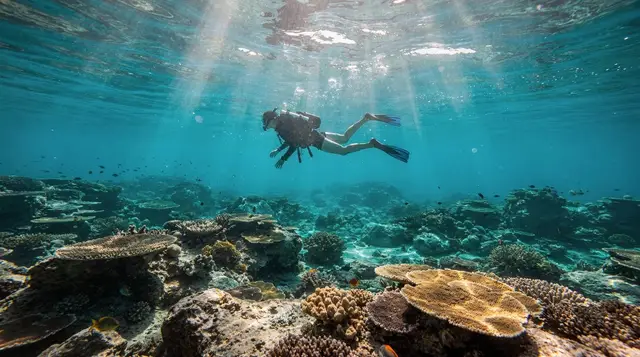
Diving season in Phuket
When is the best time to dive in Phuket?
November through April is the dry season with the calmest seas and best visibility everywhere, including the Similan Islands, which are closed entirely from roughly mid-May to mid-October. Sites closer to Phuket, like Racha Islands and the King Cruiser wreck, stay diveable year-round with somewhat reduced visibility in the wet months.
Two seasons, not one uniform answer
Phuket doesn’t have a single dive season — it has a dry season that’s good almost everywhere and a wet season where the answer depends entirely on which site you’re asking about. The Similan Islands close completely; Racha Islands and the King Cruiser wreck stay open with a visibility hit; Phi Phi and Shark Point sit somewhere in between. Anyone planning a trip around diving specifically should pick dates first, then match sites to the season, rather than booking a date and hoping the Similans happen to be open.
The dry season: November through April
This is the default answer for a reason. Seas are calmer, visibility across most sites runs 15–30 metres on a good day, and this is the only window the Similan Islands are open at all — the national park enforces a hard closure outside it, covered in more depth in the Similan liveaboard guide. Within the dry season there’s still a meaningful split worth knowing:
| Period | Conditions | Notes |
|---|---|---|
| November–December | Good, occasional residual swell from the tail of monsoon | Sites reopen but can still be choppy early in the month |
| January–February | Best all-round conditions | Calmest seas, clearest water, peak booking season |
| March–April | Warm water, good visibility, building heat | Increasingly hot on the surface between dives |
Whale sharks and mantas: a narrower window inside the dry season
If a whale shark or manta ray sighting is the actual goal, narrow the window further to roughly February through April, when sightings at Richelieu Rock (reached on multi-day Similan liveaboards) and occasionally around Koh Bon are most reported. None of this is guaranteed — whale sharks are wild, wide-ranging animals, not a scheduled attraction — but the odds genuinely shift by month, and an operator who tells you a sighting is guaranteed on any given date is not being straight with you.
Full-day Similan Islands scuba diving tripThe wet season: May through October
The southwest monsoon brings swell, rain squalls and reduced visibility, but it does not shut diving down entirely — it shuts the Similans down entirely, which is a different thing. Sites on the more sheltered side of the archipelago, and sites close enough to Phuket that a trip can be called off or rerouted on a bad-weather day, keep running:
- Racha Islands (Racha Yai and Racha Noi): the most reliable year-round pick. Some current and reduced visibility in the wettest months (roughly June–September) but rarely cancelled outright.
- King Cruiser wreck and Shark Point: diveable year-round since it isn’t inside a national park with a seasonal closure — see the King Cruiser wreck dive guide for what to expect at different times of year.
- Phi Phi and Koh Doc Mai: generally running, with more day-to-day weather dependency than Racha.
- Similan Islands: closed. Not “less popular” or “rougher” — physically closed to boats by the national park authority, typically mid-May to mid-October.
If your trip dates fall entirely in the wet season, don’t force a Similan booking — plan around Racha and the King Cruiser instead, and check the Phuket monsoon season guide for what the weather itself looks like day to day, since rain and diving conditions don’t always move together (a rainy afternoon on land can coincide with a perfectly diveable morning at sea).
King Cruiser wreck and Shark Point diving tripWater temperature and what to wear
Water temperature runs 27–30°C nearly year-round, with the slightly cooler end in the wet season and around thermoclines at depth on some sites. A 3mm shortie or full wetsuit is standard for comfort on multi-dive days; some divers skip a wetsuit entirely on shallow, short dives, but a long day of repeated dives cools you down faster than a single swim would suggest. Rash guards are a reasonable middle ground for warm-water divers who still want some coverage.
Visibility by month, roughly
| Months | Typical visibility | Sea state |
|---|---|---|
| Jan–Apr | 15–30m | Calm |
| May–Jun | 10–20m | Building swell |
| Jul–Sep | 5–15m | Roughest, most rain |
| Oct | 8–18m | Transitional, improving |
| Nov–Dec | 12–25m | Settling toward dry season |
Treat these as guidance, not a guarantee — a single storm system can drop visibility for days regardless of the calendar month, and a lucky calm week in the wet season can outperform an average day in high season.
Certification timing: when to learn vs when to dive deep
If you’re planning to get certified during your trip, any season works for the course itself — PADI Open Water in Phuket runs at sheltered sites that hold up reasonably well year-round. Save the ambitious dives — the Similans, the King Cruiser’s deeper sections — for after certification and, ideally, for the dry season when conditions favour newer divers. If you’re brand new to diving altogether, start with scuba diving in Phuket for beginners to understand what a first dive actually involves before committing to a course.
Three-day PADI Open Water certification courseSnorkelling season follows the same logic
If diving isn’t the plan but snorkelling is, the same seasonal split applies: best snorkelling spots in Phuket are calmer and clearer November through April, and the Similans are just as closed to snorkel boats as dive boats in the wet season. For a broader comparison of which activity suits your trip, snorkelling vs diving in Phuket covers the decision beyond just timing.
Building a trip around the season
If diving is a genuine priority rather than one activity among many, book dry-season dates first and build the rest of the trip — beaches, food, culture — around that window; see the Phuket diving week itinerary for a full week structured this way, and best time to visit Phuket or Phuket weather month by month for the wider climate picture beyond diving specifically.
If your dates are fixed and happen to fall in the wet season, that’s not a wasted trip — Racha Islands and the King Cruiser genuinely hold up, and Phuket in low season covers what the rest of the island looks like at that time of year, including thinner crowds and lower prices.
Crowds and booking timing by season
High season (December through February especially) is also peak booking season for dive trips, and popular boats — particularly Similan liveaboards with confirmed Richelieu Rock departures — can sell out one to two weeks ahead during the busiest weeks around Christmas, New Year and Chinese New Year. Shoulder months (November and April) offer a genuine sweet spot: still within the open, dry-season window, generally good conditions, but noticeably easier to book on short notice and often at a lower price than the December–February peak. Low season (June through September) rarely requires advance booking at all for day trips, though it’s worth checking a specific operator’s cancellation policy given the higher chance of a weather-affected day.
What changes underwater beyond visibility
Season doesn’t just affect how far you can see — it affects what you’re likely to encounter. The dry season’s calmer water tends to bring slightly more predictable fish behaviour and better conditions for underwater photography generally, since particulate matter in the water (which scatters light and washes out colour in photos) is lower. The wet season, somewhat counterintuitively, can bring more nutrient-rich water from runoff, which occasionally means more plankton and, by extension, more of the smaller reef fish that feed on it — not a trade every diver would choose, but a reasonable consolation for anyone diving outside the ideal window by necessity rather than choice.
How dive season interacts with the rest of your trip
Diving conditions and general holiday conditions mostly move together in Phuket — the calm seas that make for good visibility are the same calm seas that make beach days and boat trips pleasant generally — but not perfectly. Late in the dry season (March–April), the sea and diving remain good even as land temperatures climb toward the year’s hottest and most humid stretch, which some divers actually prefer since the water itself stays comfortably cool relative to the air.
Early wet season (May–June) sometimes still delivers decent diving days even as the rest of the island’s outdoor plans get rained out, since a wet afternoon on land doesn’t always mean a rough morning at sea. Neither pattern is reliable enough to plan around specifically, but it’s worth not assuming diving and everything else on your itinerary will always track the calendar identically.
Talking to your dive shop about the day’s actual conditions
Whatever the seasonal averages suggest, conditions on any specific day can differ meaningfully from the monthly pattern — a calm week in July or a rough patch in February both happen. A dive shop that gives you an honest, current read on that morning’s conditions rather than a generic “it’s always great here” answer is worth more than any seasonal chart, including this one. If a shop offers to swap your site on the day based on conditions — moving you from a rougher exposed site to a sheltered alternative — that’s generally a sign of a operator prioritising a good, safe dive over sticking rigidly to the original sales pitch.
A quick reference by priority
If your priority is the calmest, clearest conditions overall, aim for January through March. If it’s whale sharks or mantas specifically, narrow to February through April and confirm Richelieu Rock is on the itinerary before booking. If your dates are fixed outside the dry season, build the trip around Racha Islands and the King Cruiser rather than trying to force a Similan booking that the park authority may not even permit on your dates.
And if you’re brand new to diving and just want a first, low-stakes experience regardless of exact conditions, almost any month works reasonably well at a sheltered site like Racha — the seasonal differences matter far more to experienced divers chasing specific sites than to someone doing their first supervised dive.
Why some operators will tell you “anytime is fine”
It’s worth knowing that some booking platforms and even some operators will describe conditions more favourably than the reality on a given day, simply because turning away business is bad for revenue. This isn’t universal — plenty of shops are straightforward — but it’s a reasonable default to treat marketing copy on any single listing with a bit of scepticism and cross-check against a source with less incentive to sell you a specific date, including asking directly what a shop’s cancellation and rebooking policy looks like if conditions turn out to be poor on the day. A shop confident in its conditions will have a clear, unhesitating answer to that question.
Comparing dive season to the wider tourist calendar
It’s worth being clear that “dive season” and “tourist high season” are the same months in Phuket (November–April), unlike the split seen with activities such as surfing or kitesurfing, which favour the opposite calendar. This means the best diving conditions also come with the highest prices, busiest boats and most competition for liveaboard cabins — there’s no quiet secret window where you get dry-season conditions without dry-season crowds, at least not for the Similans specifically.
Racha Islands and the King Cruiser, being open year-round, do offer more of a genuine trade-off: slightly reduced visibility in the wetter months in exchange for noticeably thinner crowds and lower prices, which is a reasonable compromise for divers who prioritise a relaxed, uncrowded day over maximum visibility.
Planning around a fixed set of travel dates
Most travellers don’t have full flexibility to pick dates around diving conditions alone — flights, work schedules and other trip priorities usually come first, and diving has to fit around them rather than the reverse. If that’s your situation, the practical approach is simple: check whether your dates fall inside or outside the Similan season window, and if outside, plan your diving days around Racha Islands and the King Cruiser from the start rather than discovering the Similans are closed after you’ve already built expectations around them. Either way, Phuket offers a genuine dive trip nearly any time of year — the difference is which specific sites are realistically on the table, not whether diving is possible at all.
Frequently asked questions about diving season in Phuket
Can you dive in Phuket during the rainy season?
Yes, at most sites except the Similan Islands, which are closed. Racha Islands and the King Cruiser wreck stay open year-round with reduced visibility in the wettest months, roughly July to September.
When exactly do the Similan Islands close?
Typically mid-May through mid-October, though exact dates shift slightly year to year based on conditions and the national park authority’s decision. Confirm current dates directly with an operator if you’re planning close to either edge of the window.
What’s the best month for whale sharks in Phuket?
Sightings are most reported February through April at Richelieu Rock, reached on multi-day Similan liveaboards. It’s a real possibility, not a guarantee.
Is visibility ever bad in the dry season?
Occasionally, especially in November right at the tail of the monsoon. January through March is generally the most reliable window for the clearest water.
Do I need a wetsuit to dive in Phuket?
Not strictly — water is warm year-round at 27–30°C — but a 3mm shortie is standard for comfort across multiple dives in a day, and useful protection against minor scrapes on wrecks and reefs.
Is it worth diving Phuket outside the dry season if that’s all my schedule allows?
Yes, if you focus on Racha Islands and the King Cruiser rather than trying to force a Similan trip. Conditions are noticeably rougher but both sites remain genuinely diveable, and prices and crowds both drop.
tours.diving-snorkeling
Verified deep-linked GetYourGuide tours. Book through these links and we earn a small commission at no cost to you.
These are our own photographs of Phuket, not the operator's pictures of this tour — open the tour page to see those.